Raimbaut d'Orange · section 3
The pipeline: scans to site
The pipeline: scans to site
The previous section ended with a division that organizes everything in this one. The transcription happened once and created the corpus; from the corpus onward, every artifact of the edition is generated, and generated in a way that is deliberately boring. This section walks the whole path, from PDF to published page. Readers who want commands, file formats and data shapes will find them in Annex A; the aim here is the shape of the thing and the reasoning behind it.
WORKFLOW.md in the repository.A spine of page ids
Before any content work, every page got a permanent identity. The scanned
volumes are three PDFs; each page of volumes 1 and 2 receives an id of the
form v1p051 (volume 1, 51st page image), assigned simply by PDF page order.
That id never changes, and it threads through the entire system: the corpus
file is named after it, the printed-page-number table is keyed on it, every
footnote is namespaced by it, and the anchors in the published HTML carry it.
When I write provenance in this piece, this is the concrete thing I mean:
the ability to take any sentence on the website and follow it back, through
the data files, to a specific page image of a specific scanned volume.
The page id also solves a problem that sounds trivial and is not. The typescript's own printed page numbers restart, skip, and occasionally misprint; my father's cross-references cite those printed numbers, and so will anyone citing the thesis on paper. So the edition keeps both notions of "page" and maps between them: physical scan order (the page id) and printed number (read off each page by GPT-4o-mini, as described previously). The map lives in one small CSV, and the site can resolve a citation like "p. 46" to the right place because of it.
The corpus and its normalization
The corpus is 586 Markdown files, one per typescript page, and it is the single source of truth for the edition's text. Everything else in this section is derived from it and can be deleted and rebuilt without loss. Getting it into shape after transcription took one dedicated script and a set of editorial rules that the next section describes properly; the pipeline fact worth stating here is that the normalization script rewrites the corpus in place and is idempotent, meaning that running it a second time changes nothing. Corrections found during checking are made directly in these files. The corpus is, in the old sense, the manuscript.
Eight small scripts, seven data files
From the corpus, a chain of eight Python scripts derives everything the site needs. They run in a fixed order, because later scripts read the output of earlier ones:
build_manifest.pyestablishes the reading order: which pages exist, in which volume, with which printed number.assemble_book.pyjoins the 586 pages into one continuous document,book.md. This is where per-page mechanics get healed: footnote labels are namespaced by page id so that each page's "note 1" stays distinct; footnotes that overflow onto the next typescript page are reunited with their beginnings; words hyphenated across a page break are joined back together, with a log of every such repair.build_bibliography.pyextracts the thesis's real bibliography (volume 2, printed pages 470–554) into structured data: general works, works on Raimbaut, and per-chanson lists of manuscripts, editions and studies.build_catalogue.pyproduces the catalogue of the thirty-nine chansons, each with its incipit and its page ranges.build_citations.pyharvests the sigla: the thesis defines its abbreviations inline, in phrases like "(ci-après SW)", and this script collects the definitions, links them to bibliography entries, and records every place each siglum is used.build_references.pyresolves the internal references: every op. cit., ibid., art. cité is traced to the work it points at, with a confidence grade attached to each resolution.build_footnote_norm.pyprepares, for the reading views only, a per-note list of textual replacements that make footnotes self-contained (the next section explains why); the book view is exempt and keeps the printed wording.normalize_typography.pyis the in-place corpus normalizer already mentioned, run whenever a corpus page has been hand-edited.
Since the September 2026 revision there is also a ninth script,
check_verse_markers.py, which audits the printed verse numbers, and a
hand-written data file, verse-numbering.json; both are described in
section 7.
The output is seven JSON files (a manifest, the assembled book, bibliography, chanson catalogue, sigla, references, footnote normalizations) plus review reports I will come back to. Two properties of these scripts carry most of the project's maintainability, and both were chosen on purpose.
First, they are deterministic: the same corpus in, the same JSON out, every time, with no network calls and no models involved. Generative AI has no role anywhere in this stage, which means a rebuild can never quietly change the edition's text. Second, they are stdlib-only, importing nothing beyond the Python standard library. There is no dependency list to rot, no virtual environment to reconstruct in five years; any Python installed on any machine runs the whole chain. I had a small taste of the alternative during the project itself, when the vision stage's virtual environment, which does need third-party packages, briefly broke because the Python that had created it was gone. It was quickly rebuilt and works again, but the stages that must survive were built so the question cannot come up.
One tool to run it
Nobody remembers an eight-script dependency order, so the repository has a
single entry point: manage.py, a small menu-driven console tool, itself
also stdlib-only. It knows which script reads which files, compares
modification times, and shows a dashboard of what is stale. After editing one
corpus page, "rebuild stale" runs the normalizer, then exactly the scripts
whose inputs changed, in the correct order, and nothing else; other menu
choices build the site, serve it locally, or deploy. The same reasoning is
written out as a table in WORKFLOW.md ("you changed X, re-run Y"), so the
knowledge exists in prose as well as in code.
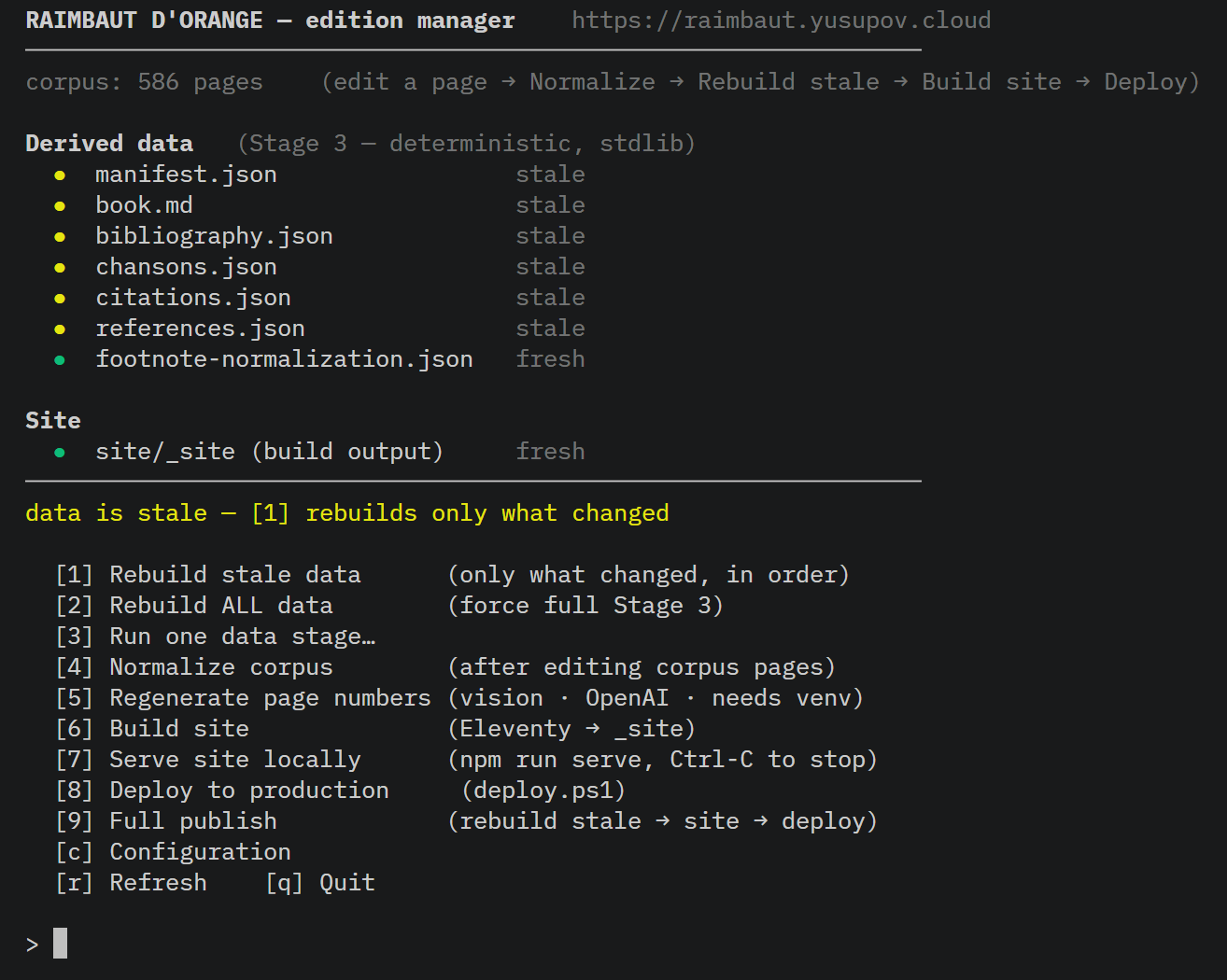
manage.py, the pipeline's single entry point. It compares file modification times across the dependency graph and rebuilds only what an edit actually made stale. Screenshot of manage.py running in the repository.Eleventy, and the shape of the site build
The website itself is generated by Eleventy, a
static-site generator: a program that runs once, at build time, and emits
plain HTML files. One data module reads book.md and the seven JSON files
and assembles them into the structures the page templates consume; the
templates then produce a page per chanson, per introduction chapter, per
essay chapter, plus the bibliography, the manuscripts table, the indexes and
the colophon. The rendering logic that makes the apparatus work — footnote
normalization gates, siglum hovercards, reference links, concordance
building — lives in a handful of JavaScript modules that run at build time,
not in the browser. What ships to the reader is HTML and CSS; the JavaScript
that does ship is comfort only (the view toggle, note synchronization,
keyboard shortcuts), and the text remains fully readable with it switched
off. The architecture section returns to why this matters for a work that
should outlive its toolchain.
Deployment is one PowerShell script: build the site, pack it into a tarball, copy it to the server over SSH, unpack. A static site makes this the whole story; there is no application server, no database migration, nothing to restart. The one lesson learned the hard way and encoded in a comment is that binary files must travel inside a tarball, because piping raw bytes through the PowerShell pipeline corrupts fonts and images.
What the pipeline adds up to
The design can be stated as one rule. Between the scans and the corpus, judgement; between the corpus and the site, none. Every place where a human or a model exercised discretion (how to read a faint word, how to normalize a dash, whether a reference resolves) either happened before the corpus was frozen or is recorded in the corpus and the hand-authored data files where it can be seen and revised. Everything after that point is mechanical, and its mechanicalness is what makes the edition correctable: a fix is one edit to one Markdown file, followed by a rebuild that cannot introduce surprises of its own.