Raimbaut d'Orange · section 2
Where generative AI entered (or not)
Where generative AI entered (or not)
Accounts of projects like this one tend to say "AI" the way one says "electricity," and her it sort of works, because different models did different jobs under different amounts of supervision, and the trust you can place in the result depends on knowing which was which. Three models touched the text of the edition, in three distinct roles, and the corpus records which pages came from which. No single model "did the OCR." (Models were also involved in a different capacity, as drafting partners in designing the site; that story belongs to the architecture section.)
GPT-4o: the bulk transcription
The first and largest job was turning 586 page images into text. Each page
of volumes 1 and 2 was rendered from the PDF scans at high resolution and
sent to GPT-4o, OpenAI's vision model, with a prompt asking for a
faithful Markdown transcription under a small set of structural conventions:
italics as *...* (these are real italics, set with the Selectric's italic
element, so the transcription records a fact about the page rather than an
interpretation), underlined runs as [...]{.underline} (underlining in this
typescript is meaningful, since it is how the sigla are marked), Occitan
verse wrapped in blocks tagged with the language (::: {lang=oc}), and each
page's footnotes as numbered Markdown notes. The output was one Markdown
file per page, named for its page id.
The previous section tells why I used a vision model rather than OCR software. OCR had been tried on this typescript years earlier, while my father was alive, and lost the race against retyping within a few dozen pages; the text layer inside the library's own digitization shows what the conventional route still produces. A vision language model reads the page more nearly the way a person does, using context to decide what a faint character must be and what the formatting around it means. On this material the improvement was large enough to change the nature of the project, from a transcription effort measured in months to one measured in hours.
The same mechanism is also the risk: a model that uses context to read a faint word can use the same context to produce a plausible word that is not the word on the page. An OCR error announces itself by looking like garbage, whereas a vision-model error looks like fluent text and announces nothing. On the French prose this risk stayed manageable, and GPT-4o's output there was close to publication quality. On the Occitan verse it was not manageable at all.
Claude: the verse, after a controlled comparison
The heart of the thesis, and the place where a plausible-but-wrong reading would do the most damage, is the Occitan verse: the poems themselves, in a medieval language, in my father's own editorial versions, whose precise readings are the point of the thesis. Raimbaut is a poet of deliberate verbal difficulty. A transcription error in the French prose is a typo; a transcription error in the Occitan can silently change a reading my father spent pages arguing for.
So the verse pages were transcribed twice, by two different models, and the outputs were machine-compared. Claude, working interactively inside Claude Code (an agentic coding environment) rather than through scripted API calls, transcribed the verse pages in session; a diff report then laid the two transcriptions side by side, chunk by chunk. Across the 43 pages of that comparison there were 997 differing chunks, and reading them settles the question at a glance. Where the typescript of Chanson I reads Cars, douz e fenhz del bederesc / m'es sos bas chanz, Claude's transcription says exactly that, while GPT-4o offered Canz, doncs e fenhz del bedeneira / m'ee sose bez chanz: fluent-looking, metrically shaped, and wrong in almost every word. The same model that was near-publication quality on French prose was inventing plausible Occitan.
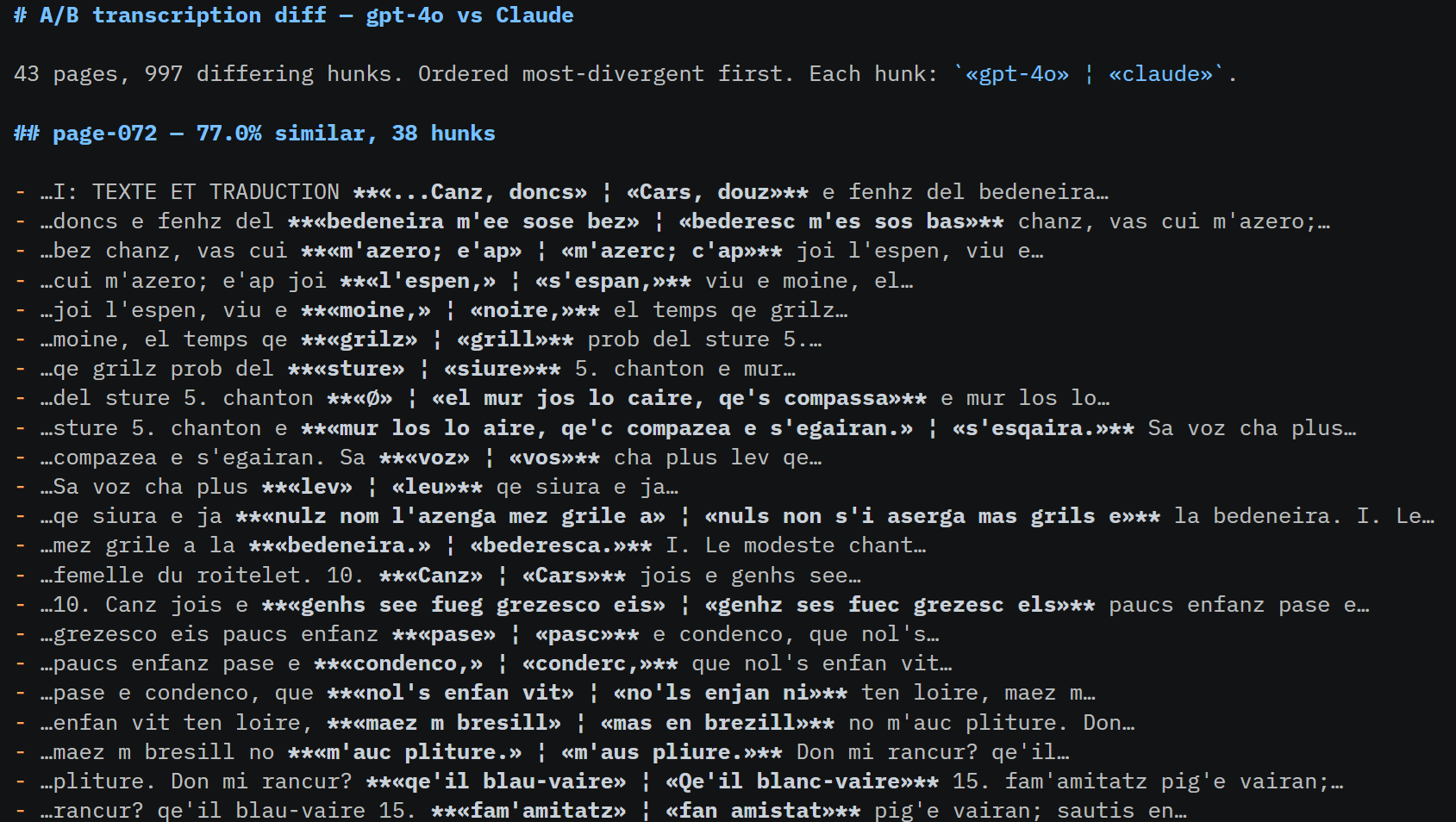
review-diff.md in the repository (restored from its history — see Annex C), pages compared during the first transcription attempt; scan of vol. 1.The corpus that everything else is built on is therefore a documented hybrid. GPT-4o's transcription is the base; the verse and other Occitan-heavy pages carry Claude's transcription instead; and a provenance table records, for every one of the 586 pages, which model's text it carries. The final tally is 499 pages from GPT-4o and 87 from Claude.
On top of the transcription came the checking. The Occitan was then read against external reference points, Walter Pattison's 1952 edition of Raimbaut and the Rialto corpus of Occitan texts online, under one standing rule: reference editions are used to detect suspicious readings, never to replace my father's. Where his text differs from Pattison, that difference is his editorial judgement, which is precisely the matter of the thesis, and the checking pass exists to make sure the difference is his and not a model's. Every difference is presented to me to resolve, never resolved automagically.
GPT-4o-mini: one narrow, boring job
The third job shows the opposite end of the technique. The edition needs to
know, for every scanned page, which printed page number it carries,
because that number is what my father's own cross-references and any future
citation of the thesis refer to. This task has none of the transcription's
difficulty: crop the top-right corner of the page image, read the number,
or report that there is none. A small script
(ocr_page_numbers.py)
does exactly that with GPT-4o-mini, the cheap sibling model, at
temperature 0, and produces a plain CSV mapping page ids to printed
numbers.
I mention this stage separately not for its difficulty but because it is the correct pattern in miniature: the narrowest possible model, the narrowest possible question, a machine-checkable output format, and a result (a 586-row CSV) small enough to be checked by eye in its entirety. Wherever an AI task can be made this boring, it is worth making it this boring.
What none of the models did
No model chose what the edition would be. No model decided that underlines mean sigla and small capitals mean names, that the annex volume was out of scope, that the corpus, once transcribed, would be hand-edited rather than re-transcribed, that unresolved references would be shown rather than hidden, or that the poem, and not the page, would be the unit of the site. No model verified its own output; the A/B comparison, the reference editions, the review reports and the flagged uncertainty are exactly the apparatus a model cannot supply for itself. And no model "understood" the thesis in any sense that would let me skip understanding it myself. I read a great deal of my father's prose very closely in those two days, which is perhaps the least automatable thing that happened.
One-time, exploratory, and honestly so
A last structural fact about the AI stage, which the rest of the pipeline depends on: it ran once. The transcription was exploratory, and it took two starts. The first attempt worked from scans I had made myself of my own physical copy of the typescript; partway in I discovered that the university library had digitized all three volumes at better quality, and the transcription was redone from the library's scans. After the corpus was finalized, the transcription scripts were deleted in a cleanup of clunky one-time code.
Deleted, it turns out, is a relative term in a version-controlled repository. While writing this piece I restored the scripts, the A/B diff report and the page-provenance table from the repository's history (they are catalogued in Annex A and Annex C), since they document the stage better than any retelling, and the prompt — quoted in full in Annex C — is the first thing anyone reproducing the approach will ask for. With those files back and the environment rebuilt, the stage could in principle even be run again. There is simply never a reason to, and that asymmetry is the principled part. Once the corpus exists and has been verified, the scans stop being the source of truth and the corpus takes over. A typo is fixed by editing the Markdown file, the way one would edit any manuscript, never by re-transcribing the page. The transcription belongs, in retrospect, with the acts that create a source rather than with the processes that transform one. It stands where hand-keying the text would have stood, and the question of whether hand-keying is re-runnable never comes up.