Raimbaut d'Orange · section 1
Raimbaut d'Orange
Raimbaut d'Orange
Turning a typescript doctoral thesis into a digital scholarly edition
What and why?
In 1981 my father defended a doctoral thesis at Ghent University. It was never published. Since July 2026 it has been a website: raimbaut.yusupov.cloud.
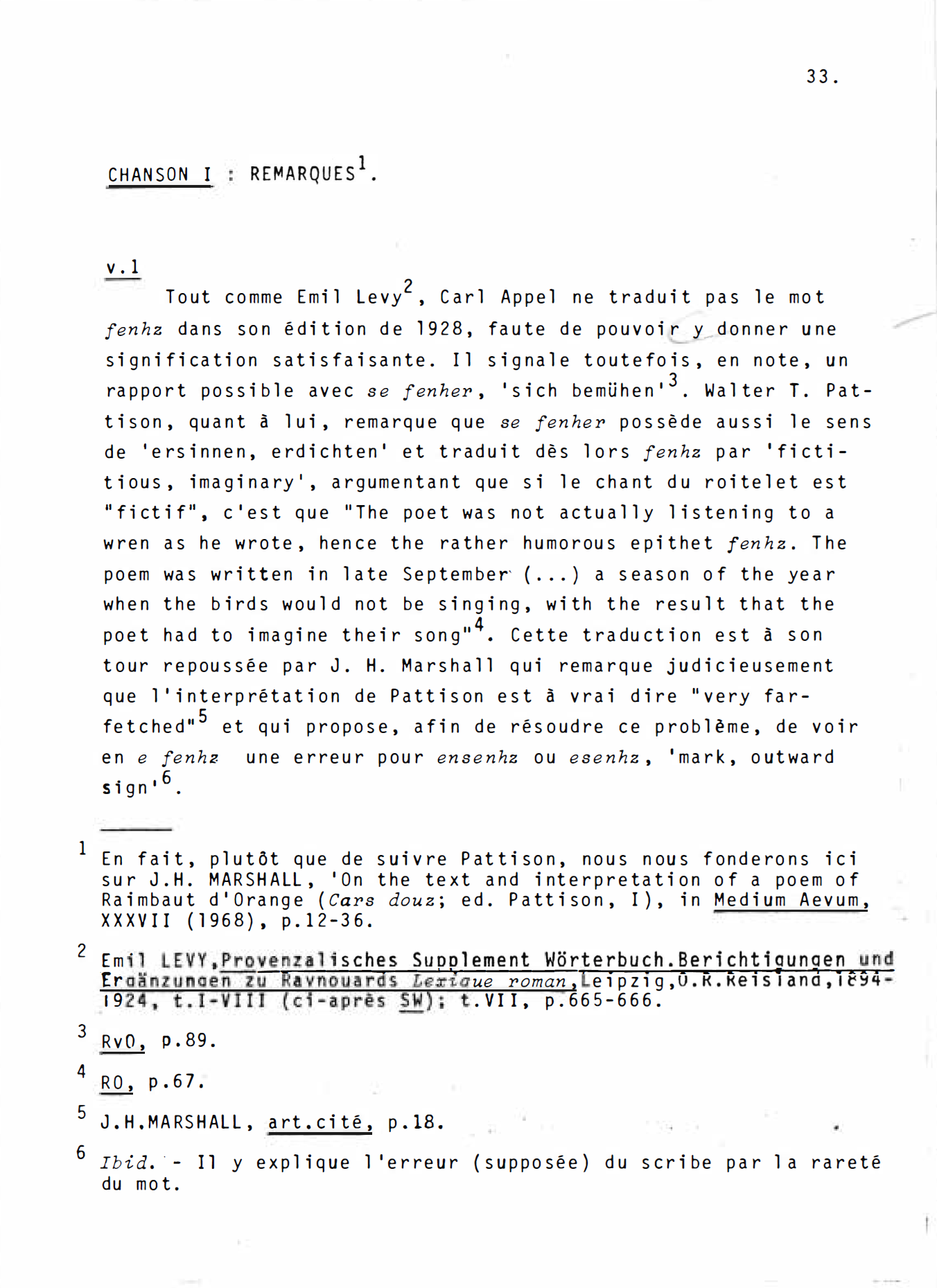
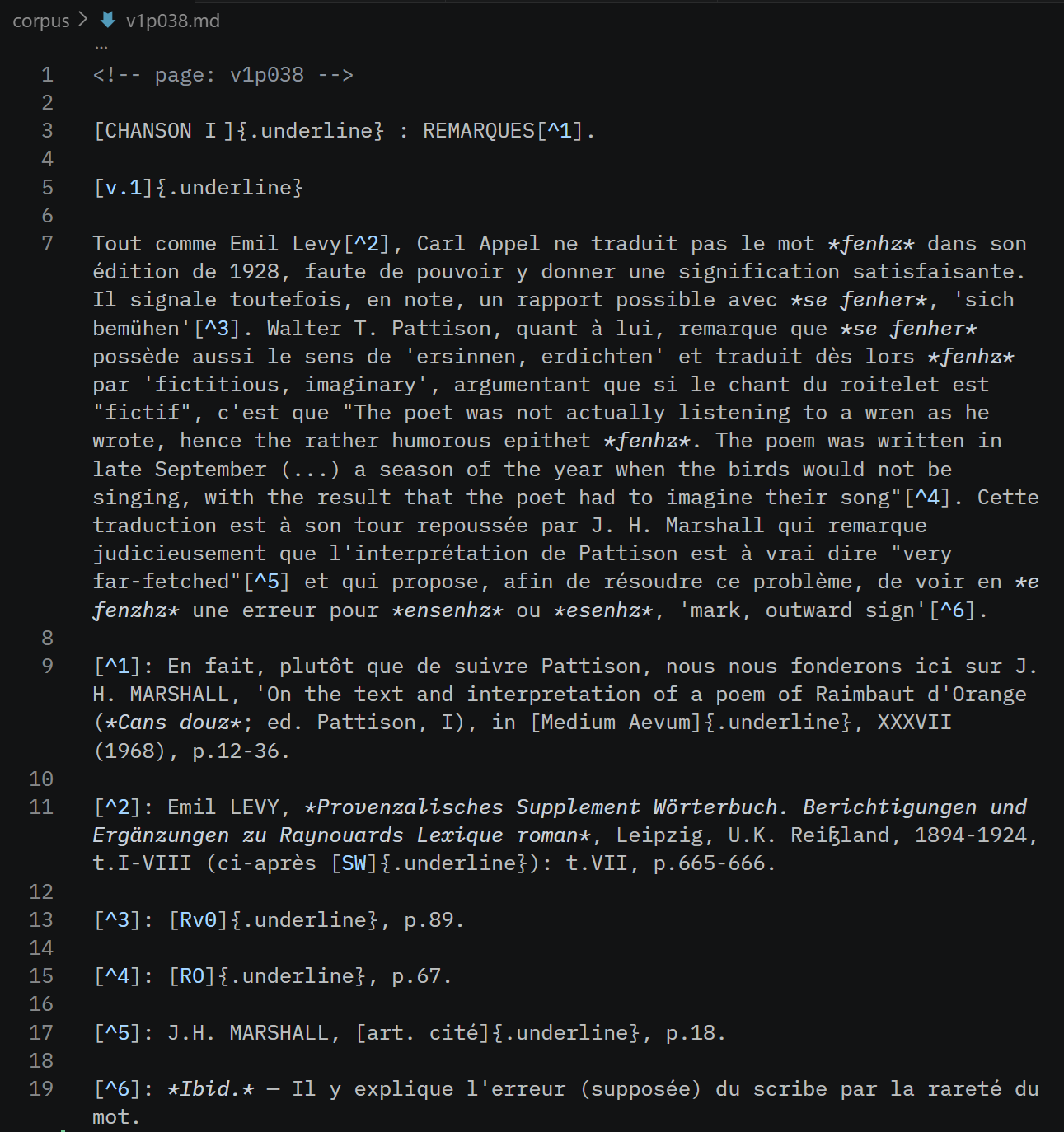
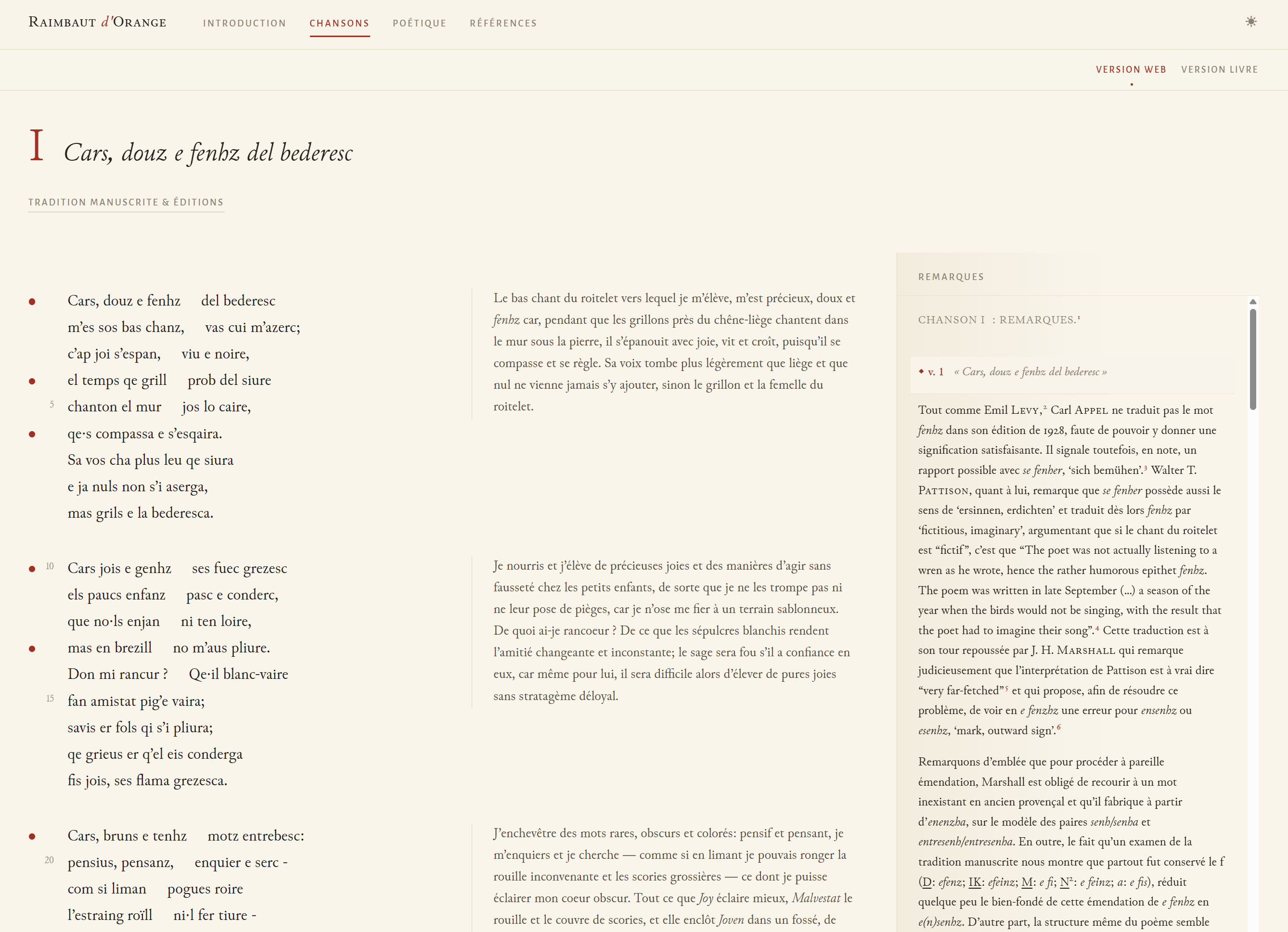
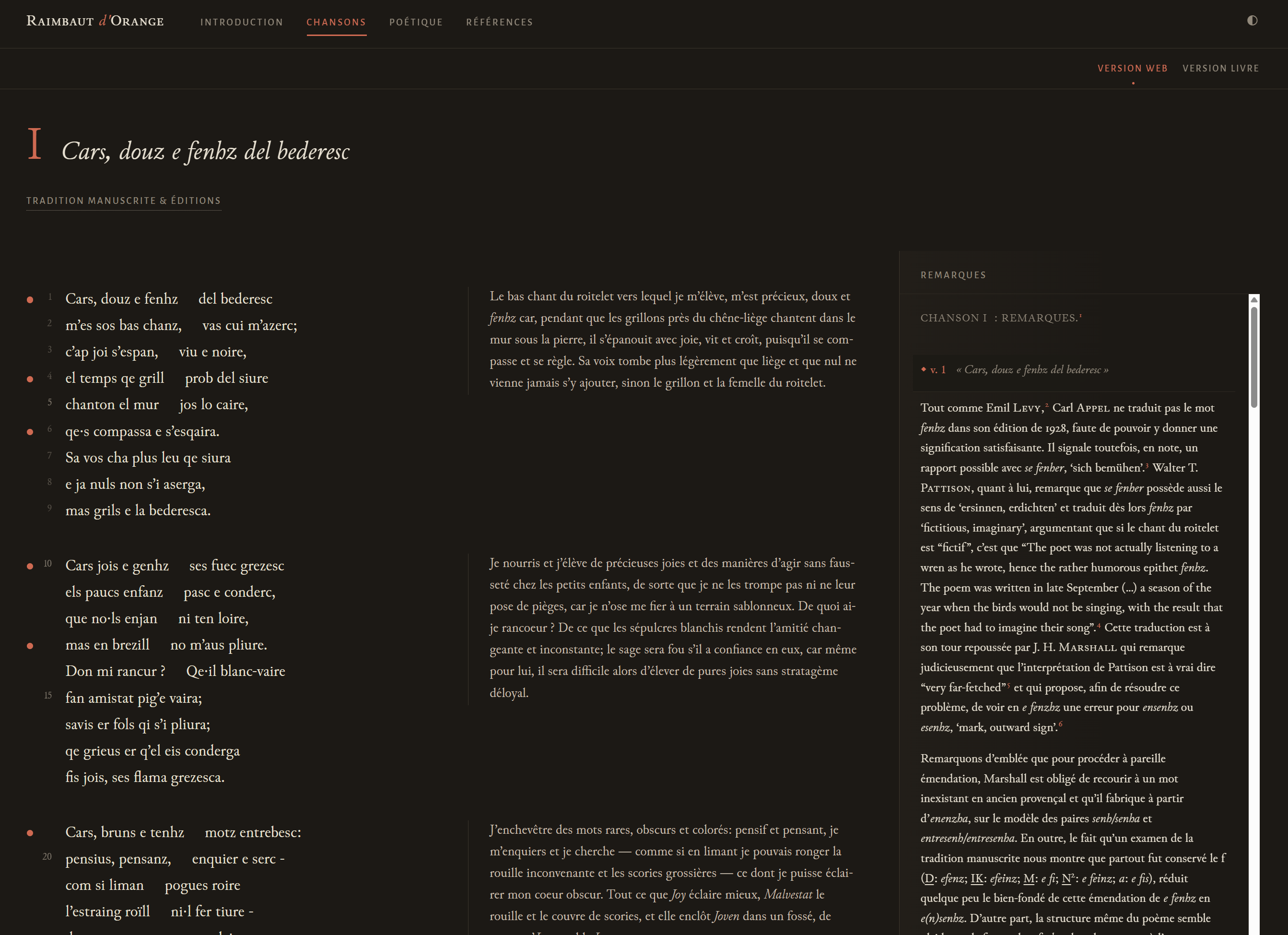
corpus/v1p051.md; raimbaut.yusupov.cloud/chansons/1/.Open any of its thirty-nine chansons and you get the Occitan poem with my father's French (scholarly) translation beside it, his commentary anchored to the verses it discusses, his footnotes reconnected to their references, and the abbreviations he used resolved against his own bibliography. Hovering over a siglum (one of the short codes scholars use for manuscripts and standard reference works: RO, SW, LR) brings up a card that says what the code stands for and links to the full bibliography entry. The thesis says op. cit. and ibid. 477 times, in the manner of older scholarship, and each of those pointers has been traced back to the work it refers to; 473 were resolved, and the 4 that resisted resolution are marked as unresolved, visibly, on the page. (These are the numbers of version 3.1; for the numbers after the September 2026 revision, see section 7.)
The same edition can also be read the other way. A book view presents each chanson in the exact order the thesis prints it, commentary first, text after, with the printed page numbers in the margin; inside it, a facsimile view gives one screen page per typescript page, with nothing normalized: names in capitals, sigla underlined as the typewriter underlined them, the handwritten corrections on the typescript marked where they occur. Anyone who wants to check the edition against the physical thesis (it sits in the Ghent University Library at Rozier 9, call number BIB.L14X.1981.VUIJLSTEKE) can do so page by page.
This piece is about how that website came to exist. A vision model, meaning an AI system that reads images rather than text, made the first step feasible where conventional OCR had failed. But "AI read my father's thesis and made a website" is not what happened, and the interesting part is everything that sentence skips. The edition was produced by a system: AI-assisted transcription, human and AI checking of the hard passages, a normalized plain-text corpus as the single source of truth, a deterministic pipeline that derives every piece of apparatus data from that corpus, a static site (plain HTML files, with no database or server code behind them) generated from the data, and a set of editorial decisions about fidelity and uncertainty that no model made or could have made. Taken separately, the parts are unremarkable. What seems worth writing down is the system, because the world is full of valuable scholarship in exactly this condition — typed, bound, shelved, and invisible — and the cost of reactivating it has just fallen through the floor.
To put things in perspective: the transcription, the checking, the data pipeline and the website were built from scratch by one person in two days, on 4 and 5 July 2026. Later sections will qualify that number twice over. The two days bought a first trustworthy edition rather than a finished one, and the checking is open-ended in a way the building was not; and the two days spent something that took far longer to acquire, because the design of the edition, from its information architecture down to how navigation behaves on a phone, drew on my twenty-odd years of working as an information architect. Still, as a measure of what used to require a funded project and a team, it took two calendar days.
The source
The thesis is:
Vuijlsteke, Marc, Interprétation "philologique" et "poétique" du Chansonnier de Raimbaut d'Orange. Diss. Doct. Letteren en Wijsbegeerte. Romaanse filologie, Ghent, 1981.
It is a Proefschrift voorgelegd tot het behalen van de graad van doctor in de Letteren en Wijsbegeerte (groep: Romaanse filologie), which is to say a doctoral thesis in Romance philology. Its subject is the chansonnier of Raimbaut d'Orange, a twelfth-century troubadour, and it works through his thirty-nine chansons one by one: for each poem a critical discussion of readings and interpretation (the remarques), then the established (but sometimes reinterpreted) Occitan text with a facing French translation. Around that core sit an introduction, a concluding essay on Raimbaut's poetics, a bibliography, and indexes.
The author was my father, Marc Vuijlsteke. He died in 2009, and I am his sole heir, which settles the rights question entirely; there is no one else to ask. That is all this piece needs to say about rights, though not quite all it needs to say about motive. He never stopped intending to return to this work, and he ran out of time -- the edition's colophon tells that story properly. For the method, which is what you are reading this for, the relevant part is simpler: I did not want to be the last person who could still find this thesis.
It is of course findable, technically speaking. A doctoral thesis is a public document: submitted, defended, deposited, catalogued. This one has sat in the university library for forty-five years, and the library has digitized all three volumes; a reasonably good scan exists online for anyone who already knows to look for it and can get access to Ghet University library digital files. It has an automatically generated text layer behind the page images that I will have more to say about shortly. What the thesis never had is a form in which a person could encounter it: no publisher, no journal, no entry in the bibliographies and databases where people actually look. Occitan studies is a small field, and a thesis that was never published is, for practical purposes, invisible even to specialists. Public and inaccessible at the same time: that condition is the real subject of this piece, and my father's thesis is one instance of a very large class.
The obvious cheap fix would have been to post the scans. Volumes 1 and 2 hold the thesis proper, 586 typescript pages (298 and 288). Volume 3 is an annex containing reproductions of his source material, the medieval chansonniers, in the form of 1970s black-and-white photocopies of such poor quality that I decided not to reproduce them at all; the edition instead links each chanson, where possible, to publicly available images of the same manuscripts from the libraries that hold them, and several of those are already in place. Posting the two main volumes would have been preservation of a sort but it would not have been enough.
The first reason for that is that a scan preserves the page but loses the apparatus, the machinery of footnotes, abbreviations, and cross-references through which a scholarly text actually functions. The thesis has 1,257 footnotes, numbered per page. It cites through 24 bibliographic sigla, defined once, deep in running prose, and used everywhere. It says op. cit. and ibid. 477 times, and such a pointer can only be followed by someone who can find the antecedent, sometimes hundreds of pages earlier. On paper, in hand, with a finger holding the bibliography open, all of this works. In a scanned PDF every one of those pointers is dead.
The second reason is that a PDF does not revive the document, and on this typescript OCR barely functions at all. I say that with some history behind it. Years ago, while my father was still alive, he and I went down exactly this road: we ran a few dozen pages through OCR software and concluded that correcting the output was costing us nearly as much work as retyping would have. The library's digitization makes the same point a second time, because the text layer behind its page images is exactly the kind of automated OCR output we had given up on, and it is abysmal. The typescript itself is cleaner than those results suggest. My father typed it on an IBM Selectric with two type elements, a regular monospace face and an italic one, so the pages carry true italics rather than the usual typewriter improvisations; underlining he reserved for the sigla, and there are corrections in pencil, in the hands of the thesis's first readers. What defeats OCR is the combination: type that is faint in places, formatting that carries meaning (an underline is a siglum, a run of capitals is a name), handwritten interventions, and long stretches of Old Occitan, a language OCR training data has no particular reason to know. And even a correct OCR reading of a siglum would only produce two or three grey letters. The apparatus stays dead either way.
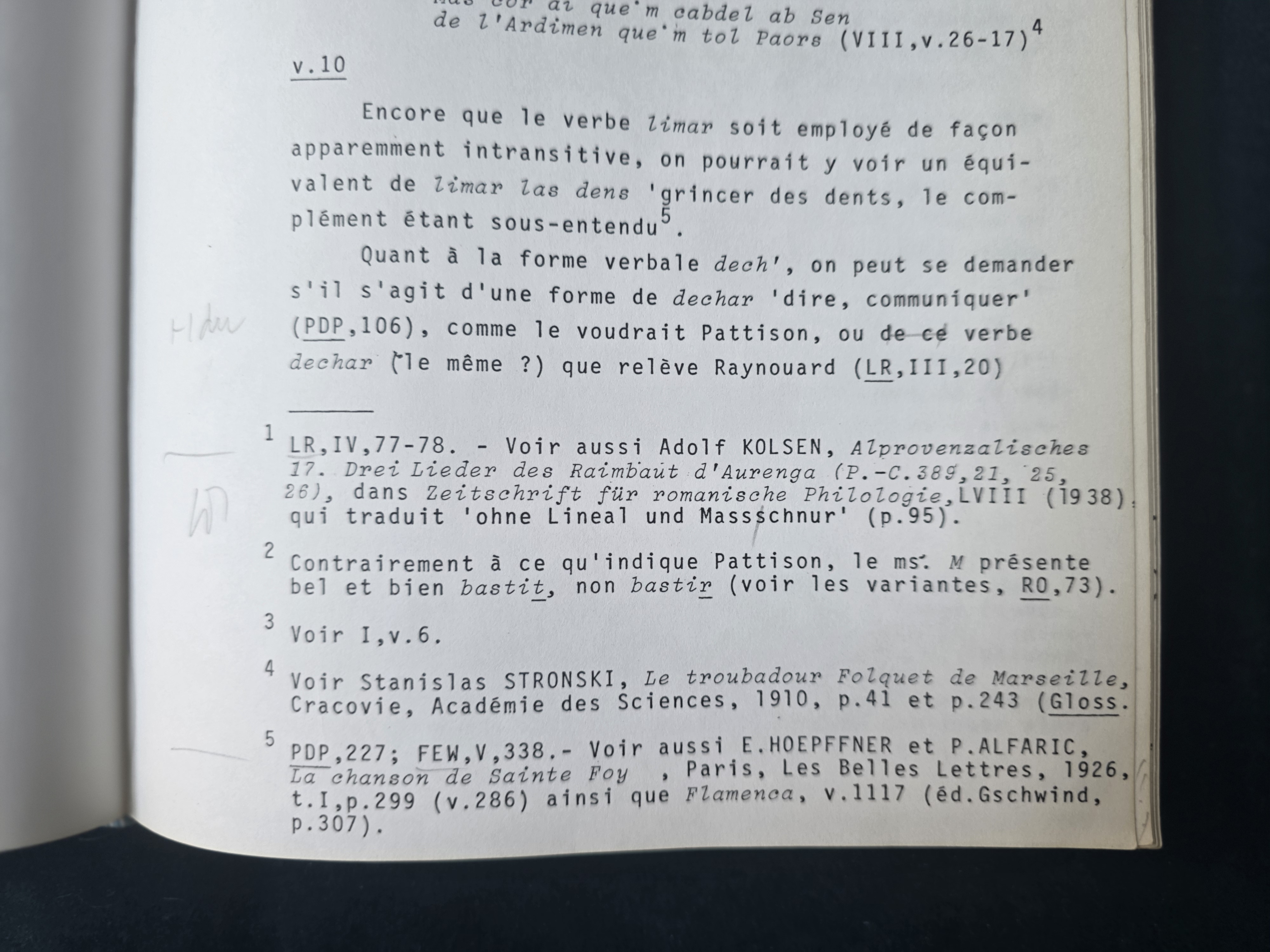
The third reason is editorial rather than technical: the thesis's structure is better than the form paper forced on it. Each chanson's commentary discusses the poem verse by verse, but the poem itself sits pages away, after the commentary, and the translations, notes, sigla, bibliography and indexes are all satellites of the poems, serialized into a single line of pages because a book has no other option. A digital edition can put the poem back in the middle and let the apparatus orbit it. That restructuring, more than the transcription, is what makes the result an edition rather than a copy. At the same time it should be said plainly that this is no new critical edition: every reading, every translation, every judgement in it is my father's, from 1981, and is presented as such. What I built is best described as the scholarly reactivation of a hidden public work — the thesis, made encounterable, with its apparatus functioning again.
The rest of this piece walks through how, in order: where exactly the AI models entered and what each one did; the pipeline from scans to website; the editorial work of normalization and honest uncertainty; the information architecture that puts the poem at the hub; the technical build; and what all this does and does not prove about reviving the rest of that very large class.