Built in a day · section 3
The build
The build
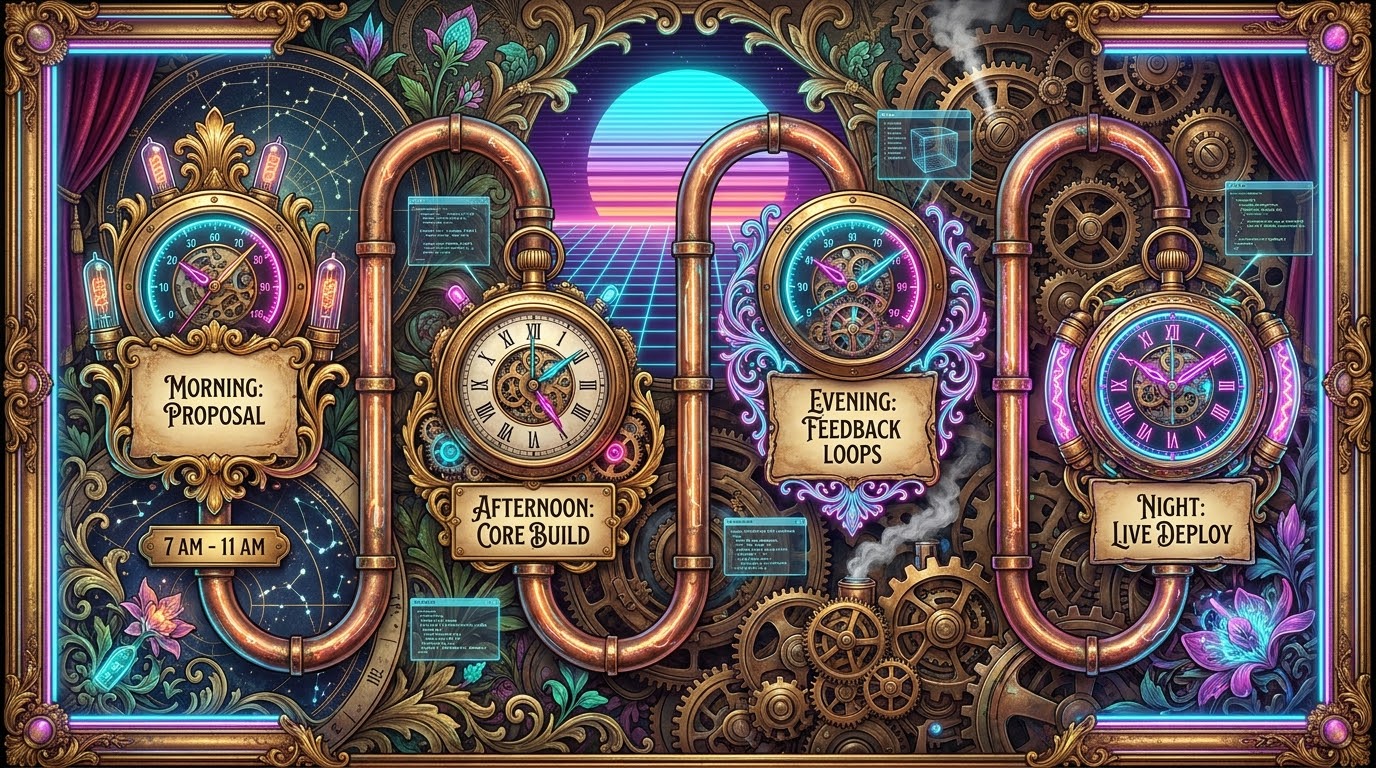
🗓️ Four Phases, One Day
Ambitious projects fail for a predictable reason: they attempt everything at once. This build did the opposite. The work was sliced into four phases, ordered not by importance but by risk — and that ordering is arguably the single best decision of the day:
| Phase | Delivered | Why this order |
|---|---|---|
| 1 | Auth, the repo clone service, the content index, the update-reading flow, commit + push | The smallest slice that proves the whole pipeline end-to-end |
| 2 | Edit content: search plus the full edit form and status transitions | Pure forms, no AI — immediately replaces most laptop sessions |
| 3 | Add to read: AI intake, reconciliation, proposal cards | The genuinely new machinery, built on proven plumbing |
| 4 | Polish: covers, PWA install, deploy indicator | Nice-to-haves, once the core is trusted |
All four phases shipped on 9 July 2026. So did the proposal, the production deploy, and three feedback rounds. One calendar day. Zero shortcuts. Buckle up — let's walk through it.
🐣 Phase 1: The Smallest Possible Victory
Phase 1 built the skeleton — login, the clone service, the content index — and one deliberately humble feature: updating reading progress. A list of the books currently being read; tap one; enter pages read or time left; submit. The cheapest write the app would ever perform, and therefore the perfect end-to-end proof. Start small. Prove everything. Then scale.
But even this humble phase contains a decision that protects all ~900 files
in the repository. The obvious way to edit front matter is to parse the
YAML, change a value, and write it back. The app refuses to do this —
because re-serializing YAML churns quoting and key order across hundreds of
hand-groomed files. Instead, writes are line-targeted: a progress update
replaces exactly the pagesRead: or durationLeft: line, or inserts it
after a known anchor, and the rest of the file stays byte-identical. Not
mostly identical. Byte-identical. Let that sink in.
Phase 1 was verified in the browser before moving on:
- ✅ An audiobook of 43u 57m updated to "20u 45m te gaan" — a one-line diff commit.
- ✅ A print book at 25% became
pagesRead: 52. - ✅ An attempt to read past the last page was rejected with a firm "Verder dan de laatste bladzijde (582 blz.)." — committing nothing.
Validation isn't a feature of the happy path. It's a feature of the unhappy one.
🚧 The Deploy: Two Hiccups, Two Lessons
The same day, the app went to production — a Hetzner VPS, gunicorn behind nginx with a certbot certificate, at boeggn.yusupov.cloud. And the deploy delivered the day's first two war stories, both diagnosed remotely from terminal output alone. Because of course it did. No deploy in history has ever been boring, and this one was no exception.
First, the systemd service refused to install because the repository still carried the unit file under an older name — while nginx and the certificate had already succeeded. The result was that most confusing of failure modes: a half-working state. The fix was the rename plus a sweep of the runbook for stale names.
Second — and this one is a classic worth framing — the app's git pull
failed with Permission denied (publickey), even though the deploy key
tested fine. The culprit: GitHub deploy keys are repo-specific, so the SSH
configuration used a per-repo host alias — but the clone's remote URL still
pointed at plain github.com, so SSH dutifully offered the default key
instead. With deploy keys, the alias must live in the remote URL itself,
not just in the SSH config. One git remote set-url later, the pipeline
breathed. Lesson learned. Lesson earned.
✏️ Phase 2: Editing Everything, Changing Nothing
Phase 2 delivered search and the full edit form — and with them, the app's most quietly impressive engineering artifact.
Search first: the index re-scans ~900 directory entries per request but re-parses only files whose modification time or size changed. Matching is accent-folded, per token, and every token must hit — so "erikson malazan" narrows instead of widening. Simple. Fast. Done.
The full-edit writer is where the stakes rise: it must be able to change any field without disturbing any other. It extends the line-targeted approach — each changed field is replaced in place, deleted, or inserted at its canonical position in the key order existing posts already use. And here is the part worth savoring: before the first real save was permitted, every post in the repository was round-tripped through the writer and verified byte-identical. Not a sample. Not a subset. Every. Single. Post. An untouched field cannot change by a single character, and that isn't a promise — it's a property, proven against the entire corpus.
Even the browser tried to sneak in a change: a textarea silently strips a leading newline, which would have deleted the blank line many posts keep after their front matter. Caught, and preserved — the save now respects each file's own blank-line style. The devil, as always, is in the details.
🐛 The Nastiest Bug of the Day
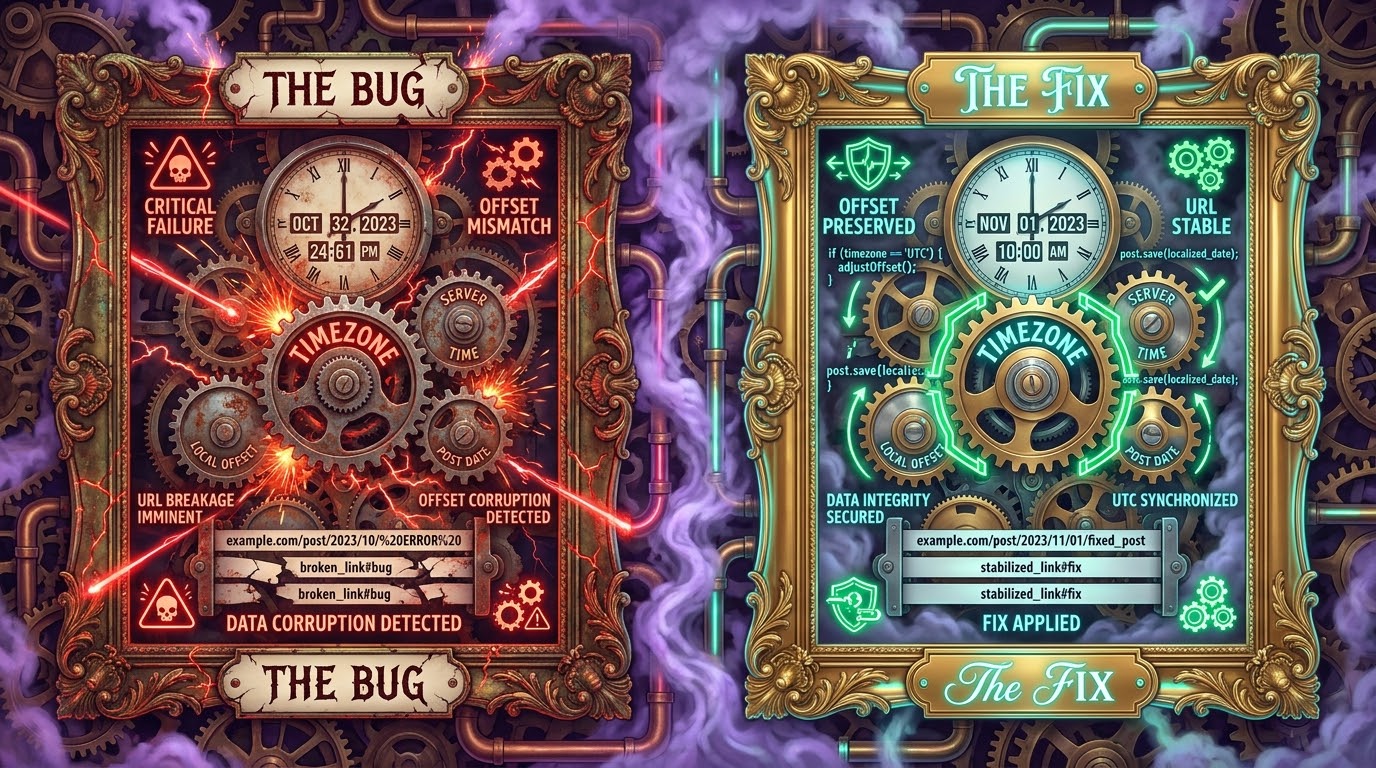
Every build has one bug that earns a section of its own. This one arrived disguised as the most innocent feedback imaginable: "make the date a date/time picker." What happened next is a masterclass in why legacy data deserves respect.
The booklog's oldest posts carry timestamps inherited from WordPress, with
offsets like +01:00 — even in summer. A naive round-trip through an HTML
datetime-local picker "normalizes" that offset to +02:00 on save. That
doesn't just reformat the date. It moves the post's wall time — and since
the site's URLs embed the year and month, it can silently move the post's
URL. A date picker that relocates fifteen-year-old permalinks: that is the
kind of bug that never announces itself. It just waits.
The first fix didn't survive contact with Django's timezone handling. The
durable rule turned out to be beautifully simple: compare wall times, and
only write the date: line when the picker shows a genuinely different
moment than the file. The same session eliminated the last remaining churn
source (an existing-but-empty field staying empty is not a change), and the
proof was re-run: unchanged submits of four differently-shaped posts all
reported "Niets gewijzigd." — and committed nothing.
By the end of phase 2, the app could already replace most laptop editing sessions. But the brief's most ambitious flow was still missing — the one where you type "the next three Malazan books" into a box and the right things happen. That story — AI, reconciliation, and a series called Ringworld that refuses to be simple — is next. Trust me: you'll want to read this one.