Built in a day · section 2
The architecture
The architecture
🔧 A Git Client with Forms
Every great architecture can be summarized in one sentence, and this one has already been said: the app is a git client with forms. Let's break it down — because the elegance is in the details, and the details are where this design truly shines.
The game-changing insight at the core of the design is that the booklog
already had a content API. It just didn't look like one. The site's git
repository is the site's data — one Markdown file per book — and git push is the publish button: the site's existing GitHub Actions pipeline
builds the Hugo site and rsyncs it to the server on every push. The app
doesn't need to replace any of that. It needs to participate in it.
Think of it as a very polite houseguest: it uses the kitchen, it follows the house rules, and it leaves everything exactly as it found it.
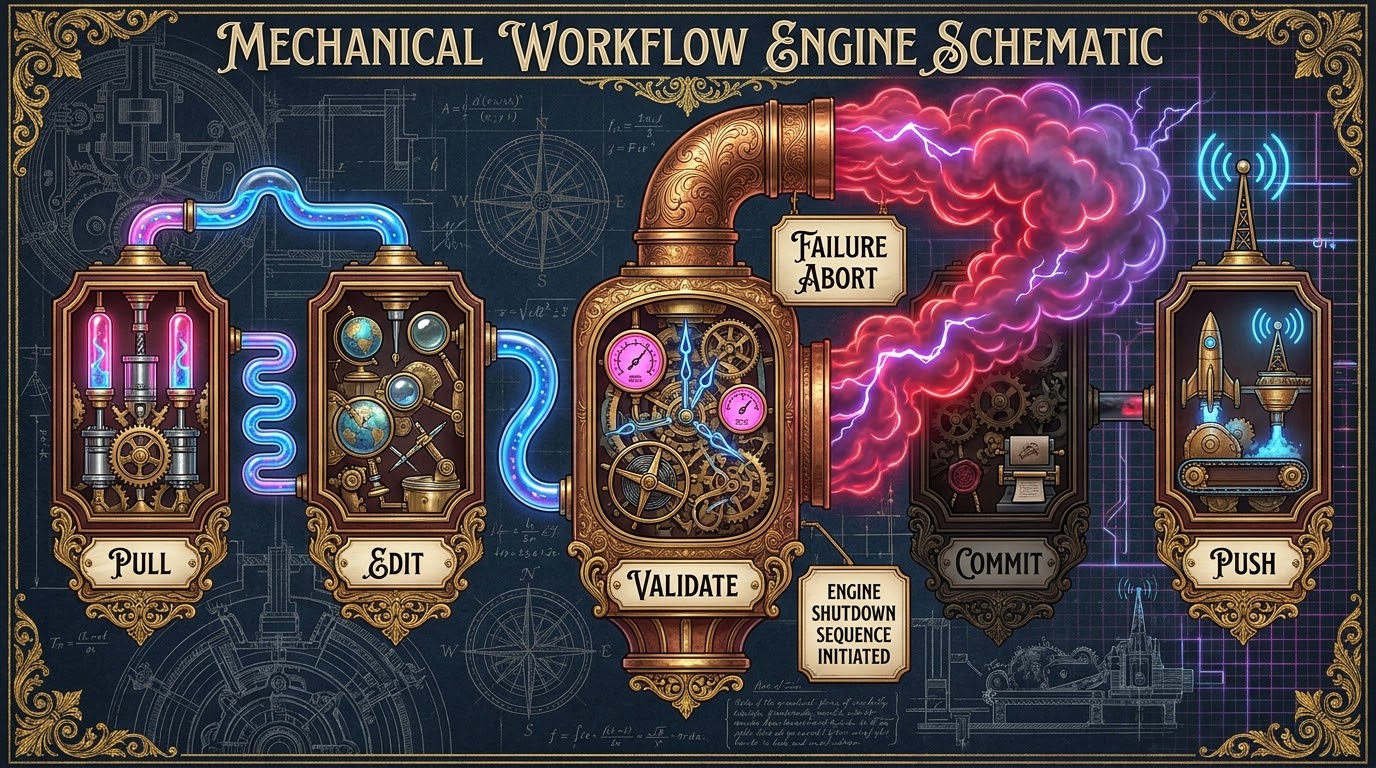
So the app keeps a working clone of the site's repository on the VPS, right next to itself. For reads, it parses front matter directly from the clone's content files. For writes, every single submit — whether it's a one-line progress update or a fully new book — runs the exact same sequence:
git pull --rebase— freshness first, which also picks up anything pushed from the laptop;- edit the Markdown — the post file, plus any author, series or tag term pages, plus a cover file when there is one;
- validate with
check_books.py— the site repository's own linter, run straight from the clone, so the rules can never drift from the site's; - commit — author "Boeggn beheer", with low-key Dutch commit messages
matching the existing history, like
Voortgang Reaper's Gale (20u 45m te gaan); - push — and the site's pipeline takes it from there.
Nothing is committed if the linter objects. Nothing drifts, because there is nothing to drift: no second copy of the content exists anywhere. The result? A robust, elegant, future-proof foundation that leverages infrastructure that already existed.
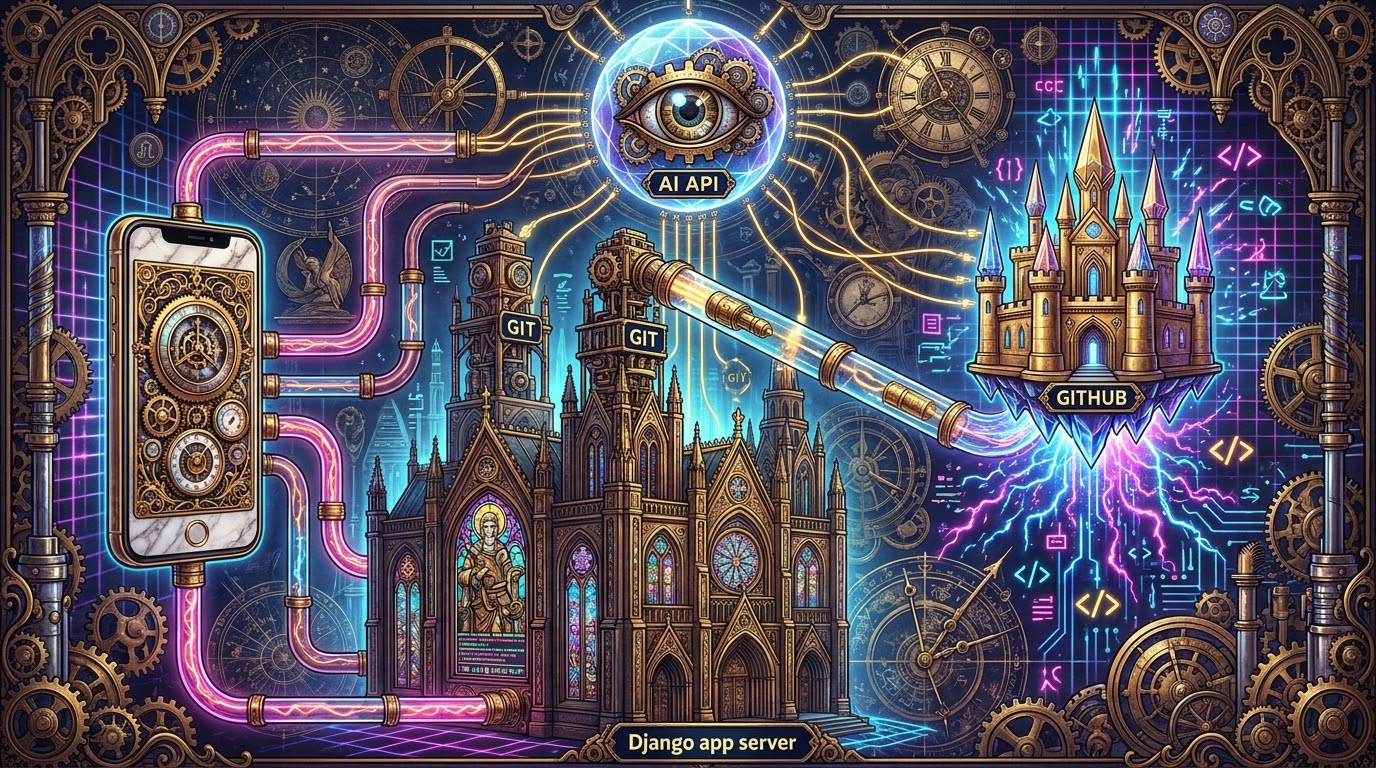
🧱 The Stack: Boring by Design
The technology choices follow directly from the philosophy, and each one is worth a brief spotlight:
- Django 5 — because login, sessions and CSRF protection come for free, and a single-user app deserves exactly zero hand-rolled auth code.
- HTMX — because three screens of forms is precisely the job HTMX was born for. No build step. No bundle. No framework fatigue.
- Plain mobile-first CSS — the app lives on a phone's home screen, so the phone is not an afterthought; it is the design target.
- SQLite — for auth and sessions only. It's worth repeating, because it is the load-bearing decision of the whole design: content never lives in a database. The site stays fully rebuildable from git alone.
Boring? Absolutely. And that's precisely the point. Boring technology is technology that works on day one, day one hundred, and day one thousand.
It's also important to note what was considered and rejected, because good architecture is as much about the roads not taken. Using GitHub's Contents API instead of a clone? Possible — but multi-file commits (a post plus author pages plus a series page plus a cover) become awkward, and you lose the ability to run the linter before committing. A React SPA? Heavier than the job, and harder for one person to maintain. Making the site itself dynamic? Explicitly out of scope — that was the one line nobody was allowed to cross.
✍️ Two Writers, One Repository
There is one genuinely subtle problem in this design, and it deserves an
honest treatment: the app is not the only writer. The laptop's working copy
— where content skills also edit books — pushes to the same main branch.
Two write locations, one source of truth. What could possibly go wrong?
Quite a lot, actually — which is why the solution is layered, and beautifully boring. Every write pulls first, so both sides stay current. A file lock serializes the app's own writers (the production server runs multiple gunicorn workers — without a lock, two simultaneous submits could interleave their git operations). And if a rebase ever fails, the app aborts cleanly and surfaces the situation as "pull the laptop changes first" — a message, not a mess. Conflicts are unlikely in practice, since different books live in different files; the design just refuses to let unlikely mean unhandled.
Key insight: guardrails aren't glamorous — until the day they are.
One more safety net rounds out the picture: in development, a GIT_PUSH
switch keeps every commit local, so no amount of testing can accidentally
deploy the live site. The publish button simply doesn't exist on a dev box.
The architecture, in short, is a bet: that the discipline which saved the site — parity, plain files, one source of truth — could also power its day-to-day life. The build is where that bet was tested. Spoiler: it paid off. But not without a fight.