Echoes · section 3
Generation
Generation
Generating the articles
The generator walks through six steps. The design principle throughout: anything that can be decided or checked in ordinary code is decided or checked in ordinary code, and the model works inside those decisions. Every model call uses strict JSON schemas (OpenAI structured outputs), so each step returns machine-checkable data, not prose to be parsed. Each completed step is checkpointed to disk, so a crashed run resumes where it stopped. After three failed attempts a step falls back to a cheaper model, and the article is permanently tagged as degraded so it can be found later.
The assignment is drawn in code, before any model writes a word. A variety module holds fifteen article genres (news analysis, obituary, interview, business-page report, reportage in the letter-from-X mode, opinion column, book review, court report, local human-interest feature, profile, unsigned editorial, arts review, science feature, reporter's notebook, and — deliberately down-weighted — the anniversary feature), each with a weight, a target length, required block counts, and its own repertoire of plausible news hooks; and five publication registers, from sober broadsheet to trade paper. Quote sources are composed per article from three orthogonal axes: an occupation from a hundred-odd trades (a canal lock-keeper, an insurance assessor, a rival paper's reporter), a stance toward the writer's argument (flatly opposed; evasive; angrier about a side issue than the main question), and a relation to the event's legacy (benefited; lost and knows it; custodian of something it created). Three sources are cast this way, occupations and stances sampled without replacement so no two share either, and the prompt insists these are casting axes, not characters — each source must get a name, an age, a workplace, and one detail that cuts against type. Every published article carries its assignment stamped into an internal field, and the next runs read those tags back: the genres of the last three articles and the hooks of the last five are excluded from the draw, so the same form cannot run on consecutive days. All of this exists because a model asked daily for "an alternate history article" converges on one template; drawing the constraints in code makes convergence impossible at the level where it matters.
Most news hooks come from the real news. Before the draw, the generator pulls up to thirty items from five live feeds — the NYT front page and world desk, the Guardian, the BBC, Le Monde — and a model call reduces them to at most fifteen "event skeletons": one- or two-sentence story shapes with every proper noun, date and period-bound artifact stripped out, but the human specificity kept ("a repair bill for a beloved public clock exposes that nobody can say who owns it"), each tagged with domains such as law, transport, or religion. Genres that take an open hook draw one of these skeletons seventy per cent of the time, filtered to the genre's domains; the selection step is told the shape is binding but every particular — names, places, institutions, period — must be invented natively inside the article's world. Another twenty per cent of draws compose a seed from a domain crossed with an occurrence shape ("a shortage, glut, or price shock" in "agriculture, food, and drink" — some three hundred and fifty combinations), and the remainder falls back to a static pool of twenty-nine written hooks, which is also where the occasion-bound genres always draw: an obituary needs a death, a book review needs a book. The reasoning is that real news never repeats and never regresses to a genre mean, which makes the wire a better variety source than any hand-written pool — provided only the shape survives. If the feeds are unreachable, the skeleton stage fails soft and the composed and static pools carry the day.
Step 1 — selection. Five unused events matching today's month and day (CE only, and at least fifty years old) are sampled from the database. The model is given the assignment and the five candidates and returns the one best able to support that exact genre and hook, along with a divergence date, a publication date (at least fifty years after the divergence, within the last hundred years, and explicitly not near the event's anniversary unless the hook is an anniversary), a concrete news hook — who died, what was ruled, what broke — a publication context (name, city, editorial stance, intended readership), an angle for the piece, and a note of which subjects would photograph well. The code verifies the chosen event was actually among the candidates.
Step 2 — the world brief. A second call produces an internal dossier the writer must follow: a timeline of at least five dated developments between divergence and publication date, canonical facts to preserve, real-history traps to avoid, named entities, and — this matters most — friction. The brief must contain a question people in that world genuinely disagree about, at least two groups for whom the change turned out badly and whose grievance is still alive, and two to four current problems (disputes, shortages, strikes, price rises) usable as texture. The prompt's central rule is proportionality: change only what the divergence actually changes, and the further a domain is from the causal chain, the more it should resemble real history. The brief also invents the writer — a persona with an age, a history at the paper, and a visible bias — and sketches a visual brief for the photo editor: subjects worth shooting, with the reason each fits.
Step 3 — the draft. The article is written in one pass, in the language of the source event, opening from the news hook rather than the historical event. The prompt includes a period style anchor: the variety module keeps, for each language and each of six eras, a list of the era's stylistic markers plus a short original pastiche paragraph — clipped wire-service prose for 1914–1945, colour-supplement irony for 1976–1999 — which the model is told to match in register and rhythm but not in content. The prompt also carries a digest of the last ten published articles (titles, subtitles, and final paragraphs) that the new piece must not resemble, and a list of banned motifs compiled from observed convergence in earlier output — among them the closing scene in which the writer walks along a waterfront and reflects, and the two-clause aphoristic final sentence ("The engines are new; the task is old."). A structural rule backs the ban: the final paragraph must end on a fact, a scene, or a quote — never an aphorism or a restatement of the thesis.
Step 4 — critic and revision. Before any model critique, a mechanical scanner goes over the draft in plain code: regular expressions for "not X, but Y" constructions in the article's language, counts of em-dashes and exclamation marks, heuristics for epigram endings and aphoristic callouts, and a check for quote casting that leans too academic. Its findings seed a critic pass — a model call prompted as an outside line editor that lists up to twelve defects, each with the exact offending sentence quoted and a concrete fix, hunting in order for machine accents, period mismatch, resemblance to recent articles, missing friction, in-world leaks, and genre drift. If defects are found, a revision pass rewrites exactly those sentences and nothing else. The revised article then passes through hard validation in code: the dates are overwritten with the canonical ones from step 1 (the model is not trusted with them), the publication name is rejected if it contains any meta term like "alternate" or "uchronie", block minimums for the genre are enforced, and no quotation may be attributed to the article's own author. The same checks run again server-side in the API serializer, so even a buggy client cannot publish a meta-named publication.
The system prompt shared by all steps enforces the in-world frame with a flat vocabulary ban: the visible text may never contain "in our world", "timeline", "divergence", "what if", or comparisons to real history — internal planning fields may reference real history freely, visible article text may not.
A worked example. One run drew the anniversary feature — the single genre the module deliberately down-weights — in the sober-broadsheet register, with three quote sources cast in code: an antiques dealer who argues both sides in a breath and lost by the outcome, a hospital porter angrier about a side issue than the main one, and a cartographer flatly opposed to the writer's line. From five candidate events for the date, the model chose this one:
[10156] 1973-07-12 — A fire destroys the entire sixth floor of the National Personnel Records Center of the United States.
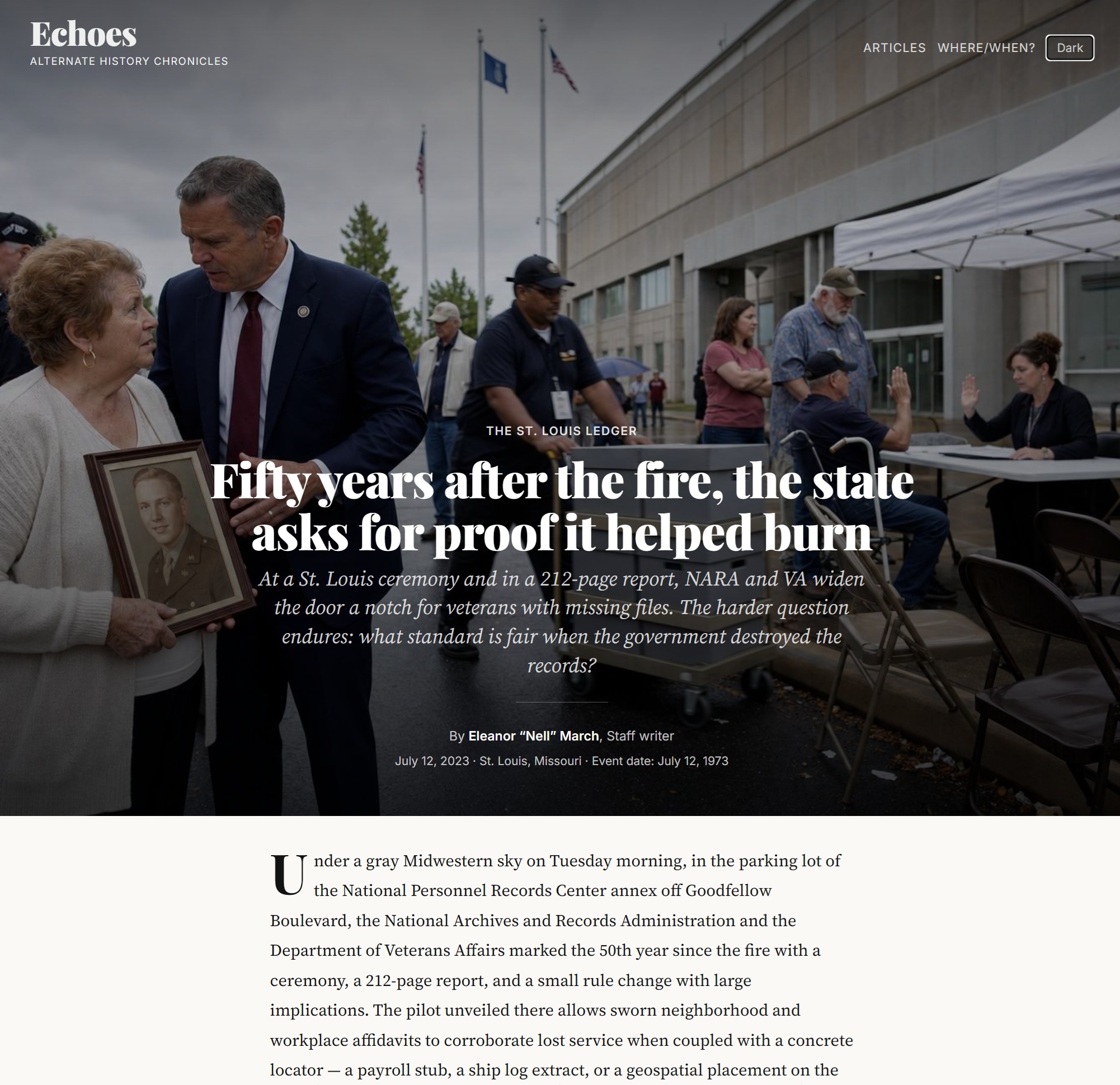
The brief made the divergence concrete: the fire burns unchecked for nearly two days instead of being contained, destroying most United States service records from 1912–1968, and the loss drives fifty years of litigation and repair — a Veterans Proof Act, a geospatial "Muster Map" program that reconstructs service from payrolls and ship logs, a running national argument about fraud versus redress. The resulting article is dated 2023-07-12, fifty years on, in an invented St. Louis daily, and — as the form demands even of an anniversary piece — opens not on the fire but on this week's news of it:
Under a gray Midwestern sky on Tuesday morning, in the parking lot of the National Personnel Records Center annex off Goodfellow Boulevard, the National Archives and Records Administration and the Department of Veterans Affairs marked the 50th year since the fire with a ceremony, a 212-page report, and a small rule change with large implications. The pilot unveiled there allows sworn neighborhood and workplace affidavits to corroborate lost service when coupled with a concrete locator — a payroll stub, a ship log extract, or a geospatial placement on the long-running Muster Map.
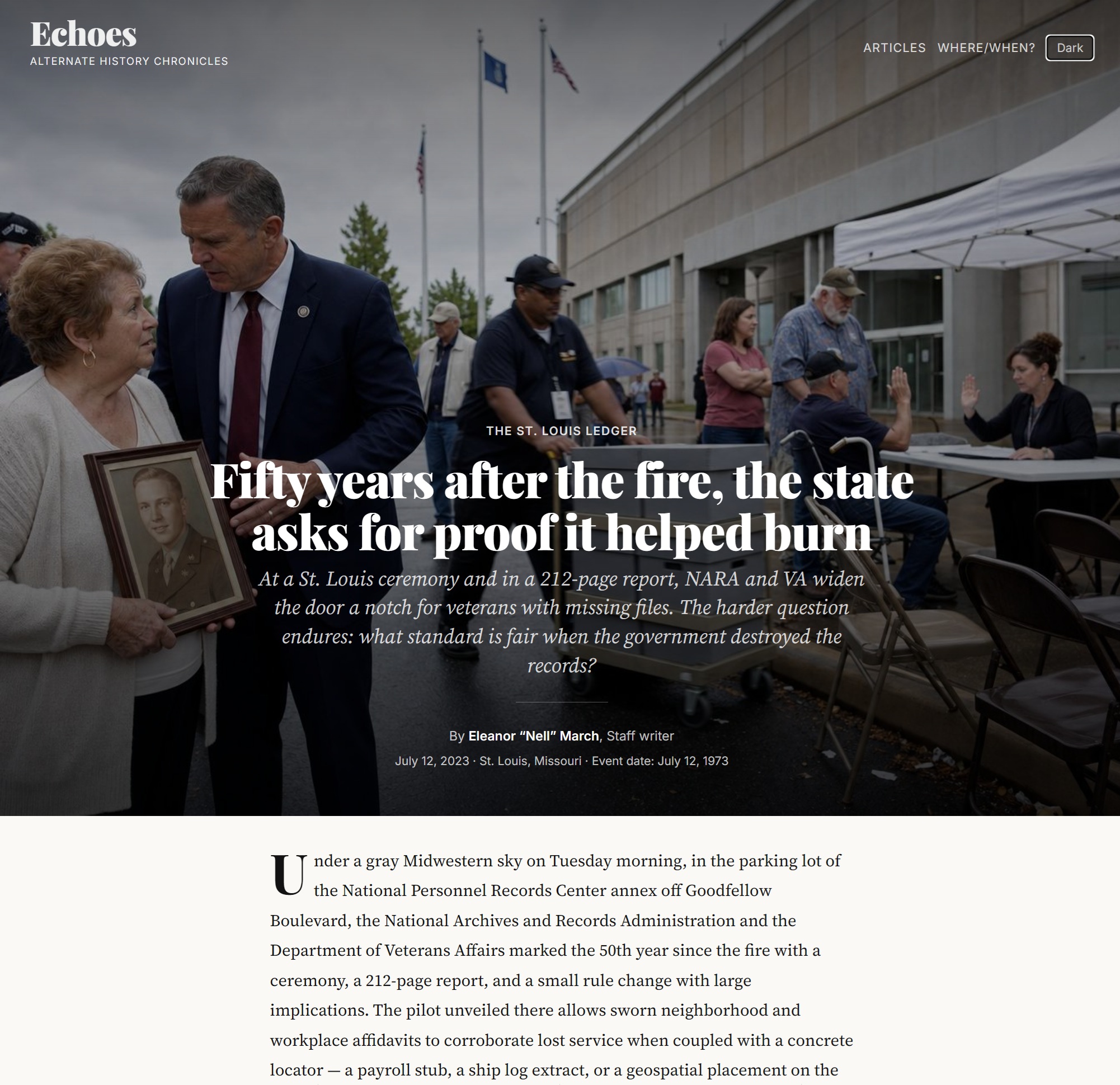
Generating the images
Images get their own step after the article is final. A model call prompted as a photo editor working inside the article's world proposes one to five image concepts — one hero, the rest supporting — each with an English generation prompt, an aspect ratio, and alt text, caption and credit in the article's language. The concepts are asked to prefer oblique, story-bearing scenes (a corridor conversation, a loading dock, a kitchen table) over ceremonial ones, and to default supporting images toward objects, documents, interiors and streetscapes rather than people.
The prompt encodes a table of visual technology by publication date: an article dated 1870 gets wet-plate collodion with its chemical artifacts, one from 1950 gets flashbulb press photography on Tri-X-like stock, one from 1990 gets colour film with a named cast, pre-1840 gets engraving or oil painting with a specified school. Before generation, code wraps each prompt with medium-specific instructions — one wrapper for photographs (grain, uneven lighting, imperfect focus, "candid press photo, not posed"), one for paintings and prints (brushwork, plate marks, craquelure), one for object studies (patina, foxing, neutral archival lighting) — plus a common prefix against the failure modes of image models: cloned faces, mirrored poses, tidy formations, perfect symmetry, and any text or lettering in the image. "Dramatic lighting" and "cinematic" are banned outright because they reliably produce the AI-art look.
A possible enhancement is left open: currently no check compares the generated image against the article — consistency is enforced only by prompting, not verified afterwards.
Generated images come back as PNG, are converted to JPEG, uploaded through the media API (which checks file signatures and size and stores the prompt as the image description), and attached: the hero becomes the article's featured image, and supporting images are inserted into the body at evenly spread positions, with a rule that an image never lands directly above a section heading.
The results are period-plausible rather than period-authentic. A reader who knows photography will find tells — the processes are described to the model, not simulated — and the captions claim archives that do not exist. The images are meant to carry the same fiction as the text, at the same level of craft, not to survive forensic inspection.
| Image | The prompt the model wrote for it |
|---|---|
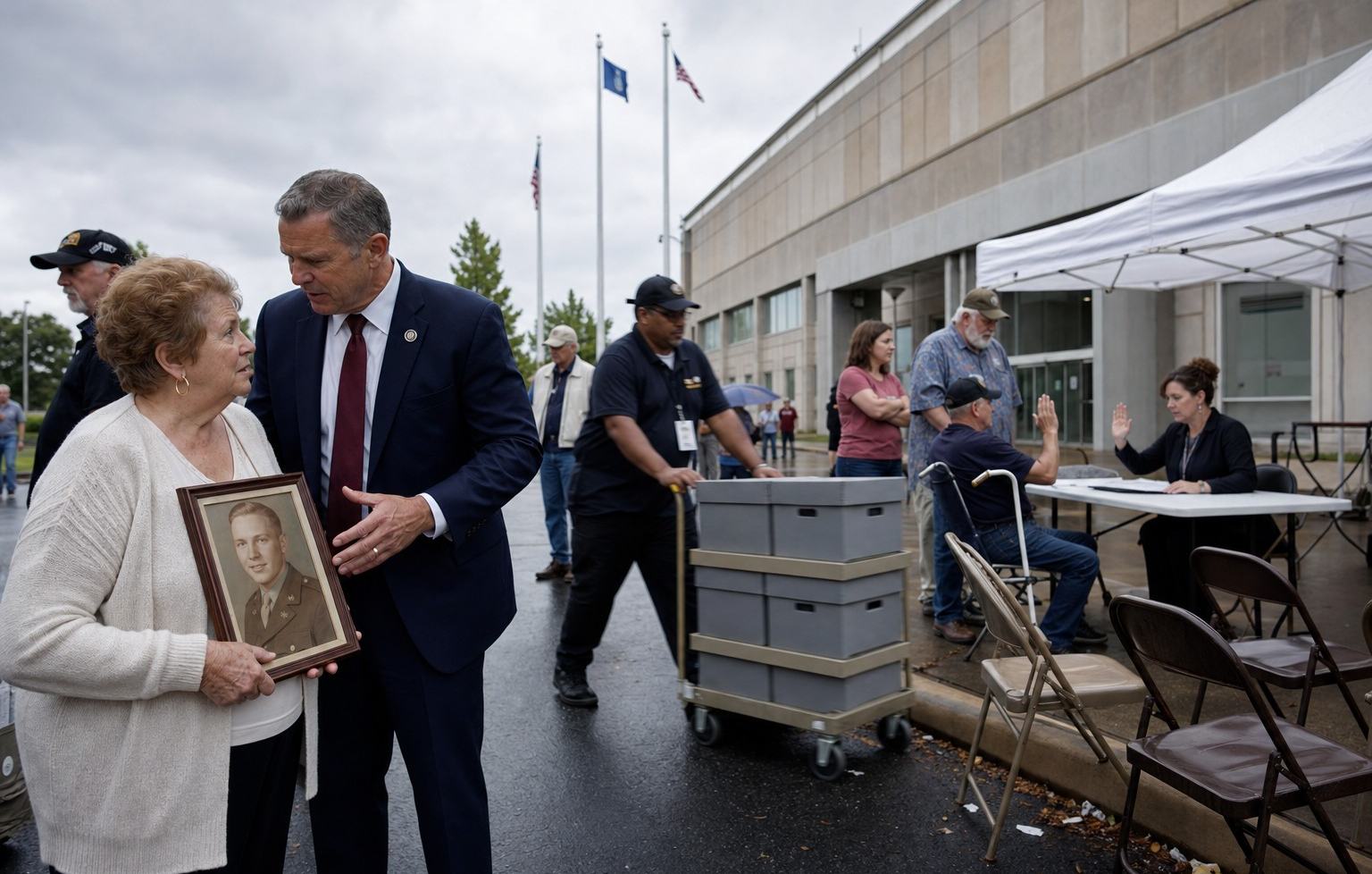 |
Hero — the ceremony, 2023. Documentary photograph taken July 11, 2023 outside the National Personnel Records Center annex in St. Louis. Asymmetric, candid composition from shoulder height with a full-frame DSLR and 35mm lens at f/4. The dominant subject is an older woman in a light cardigan standing left of frame, holding a framed portrait of a serviceman at chest height; a VA official in a dark suit leans slightly toward her mid-conversation. Midground shows a records cart with gray archival boxes being pushed past a small tent where a staffer administers a sworn affidavit at a folding table; a few veterans and family members of varied ages stand or sit in scattered folding chairs. Overcast sky, flagpoles and the annex facade recede at a diagonal. Natural color, gentle falloff toward the edges, slight motion blur on the cart wheels, fine high-ISO noise in shadow areas. No readable text or signage in frame; incidental litter near a curb and water spots on asphalt after a light drizzle. |
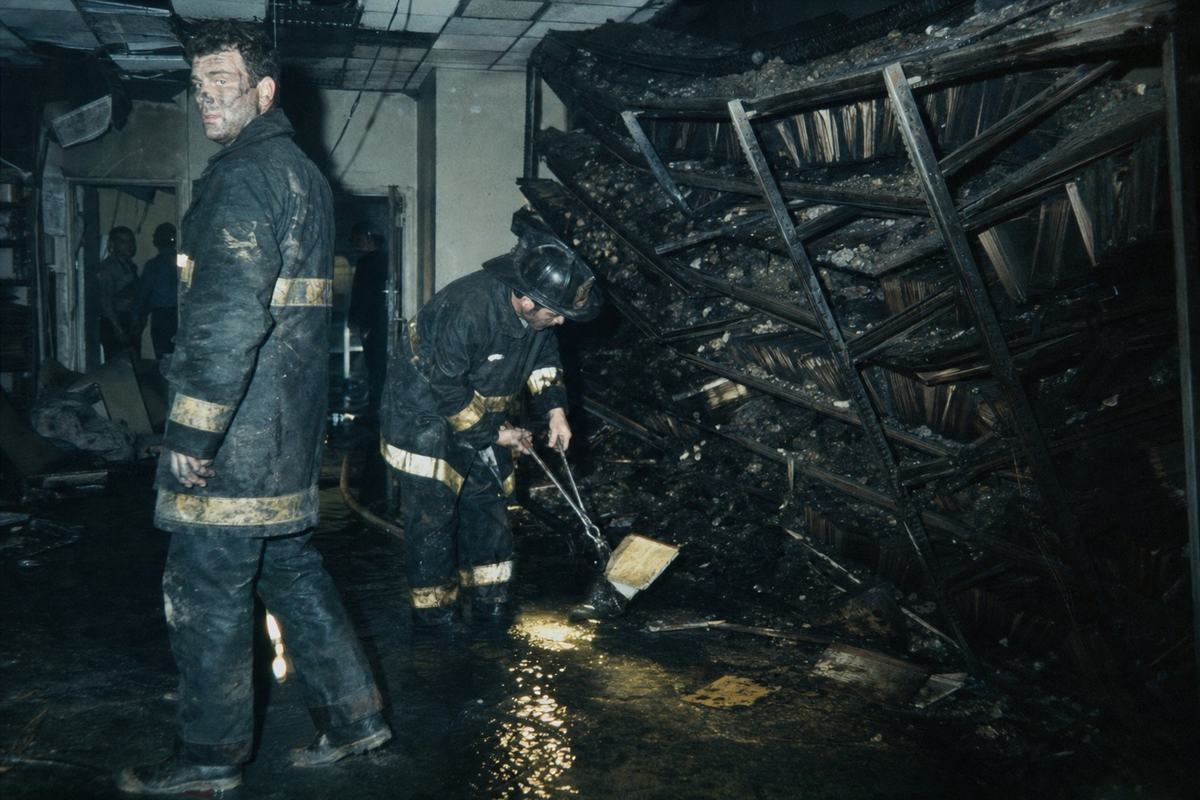 |
Supporting — the fire, 1973. Archival photograph from inside the NPRC building in July 1973. Shot on Ektachrome 64 color slide film with a 28mm lens, handheld; visible blue-green color cast, moderate grain, slight motion blur on moving figures. Off-center framing shows charred metal shelving sagging to the right, smoke-blackened ceiling above, and pools of water reflecting flashlight beams on the floor. Two firefighters in turnouts move through wet debris; one is half-turned, face distinct and streaked with soot, the other bends to lift a warped folder with tongs. Incidental background detail includes fallen ceiling tiles and a hose snaking past a doorway. No readable text visible anywhere in the scene. |
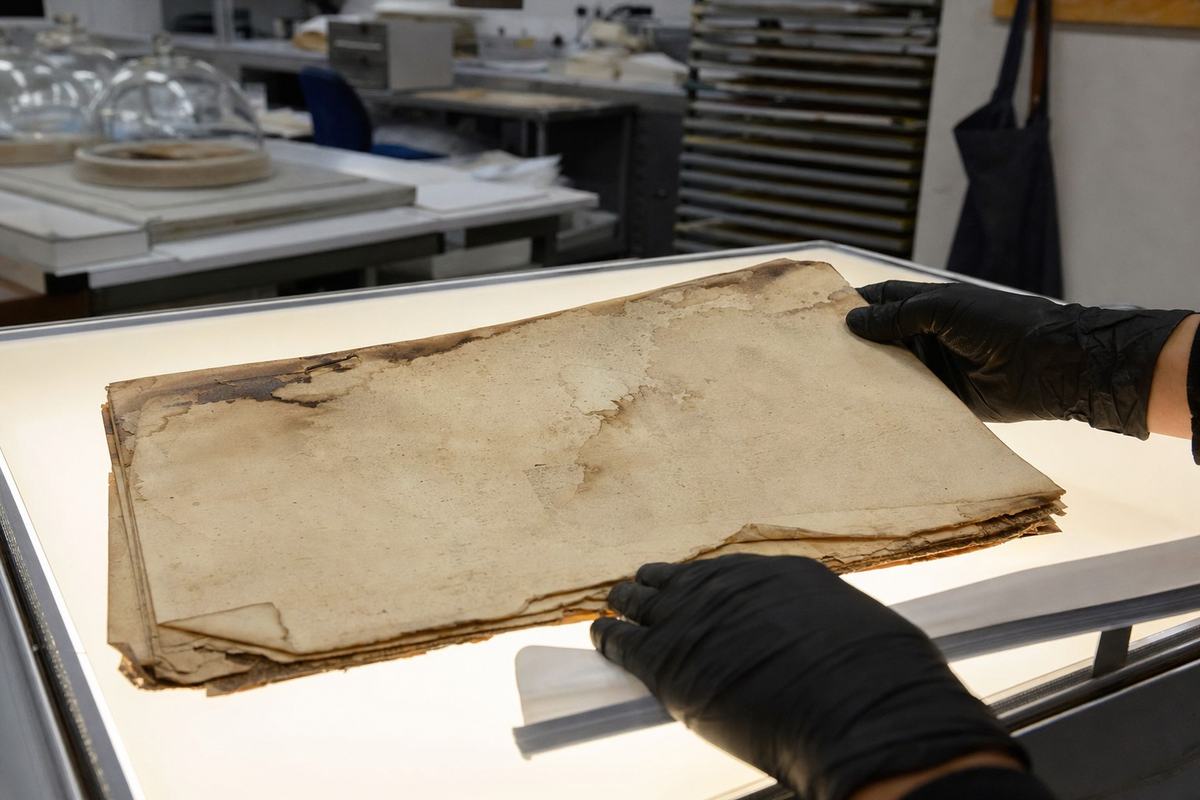 |
Supporting — the reconstruction lab, 2023. Documentary close-up photograph inside the NPRC Reconstruction Lab, 2023. Shot with a full-frame DSLR and 100mm macro lens at f/5.6. The dominant action is a pair of gloved hands stabilizing a warped personnel folder on a backlit light table; paper fibers, water wrinkling, and singed edges are clearly visible. Background shows humidity domes, drying racks, and a conservator's apron hanging on a peg; labels and barcodes are turned away to avoid readable text. Soft spill from overhead fluorescents, shallow depth of field with the hands and paper crisp and edges falling out of focus; minor sensor noise in shadows. |
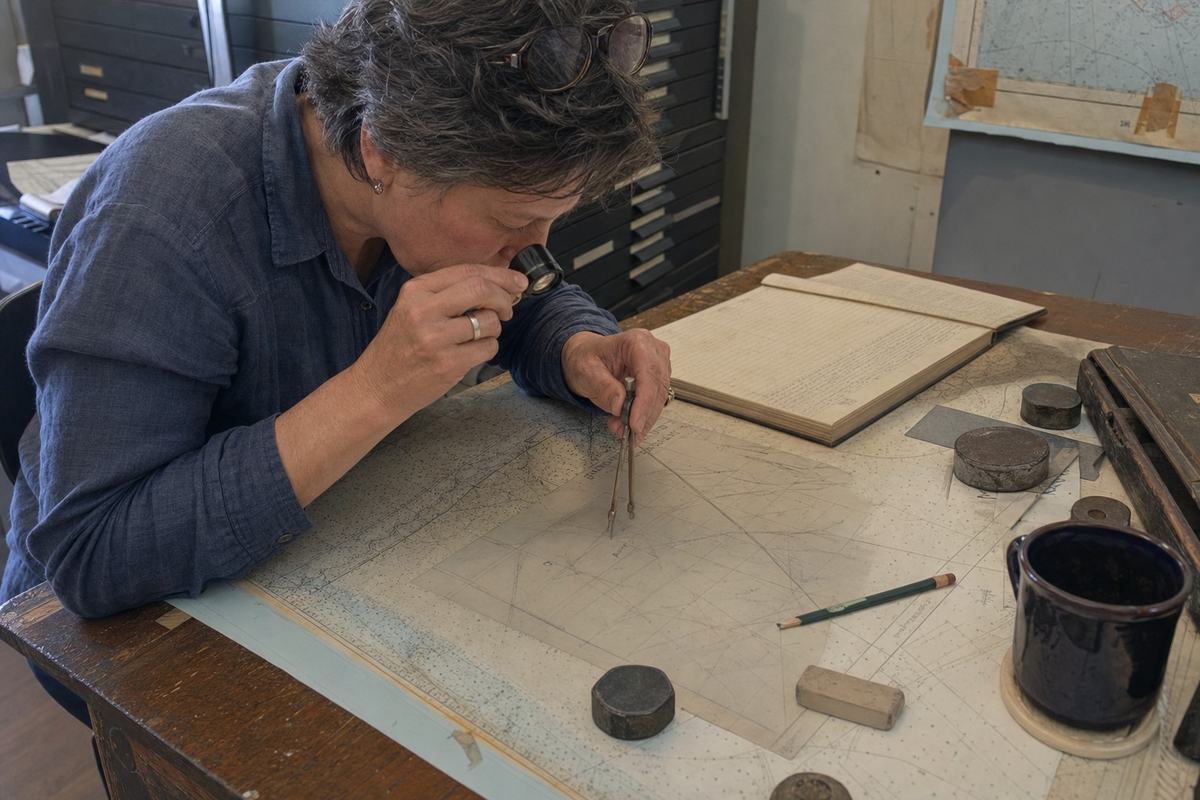 |
Supporting — the geospatial desk, 2023. Documentary photograph of a cartographer's drafting desk in a St. Louis studio, 2023. Captured with a mirrorless camera and 50mm lens at f/2.8 from a standing angle over the left shoulder. The dominant subject is a middle-aged woman with short, graying hair and wire-rim glasses pushed up, leaning in with a magnifier to compare a Navy deck log page to a coastal chart; her right hand holds a compass divider over an acetate overlay marked with grease pencil lines. The desk is cluttered with map weights, an erasable pencil, and a coffee mug ring; computer monitor kept out of frame. Fluorescent overhead light, natural skin texture and fine lines visible, slight lens vignetting. Any text on charts or logs is angled away and unreadable; background shows flat files and a rolled wall map edge with worn tape. |
Editorial control and plausibility
The text and image pipelines share one idea: the signals that make something read as real news are mostly signals of friction and imperfection, and a generative model left to itself produces neither. So the system manufactures them:
- Variation is structural, not stylistic. Article length runs from a 700-word unsigned leader to a 2,000-word feature; some genres forbid section headings, others require three; the quote casting changes daily. None of this is the model's choice.
- Disagreement is mandatory. Every article must take a side a reasonable reader could reject, quote at least one source who pushes against the writer, give a loser of history space and voice, and criticise an institution its own readers respect.
- The world is unfinished. The brief's required frictions — the strike, the price rise, the unresolved lawsuit — keep the alternate world from presenting as a solved success story, which was an observed failure mode.
- Knowledge is assumed, not explained. Writing from inside the timeline means the article cannot explain what its readers would already know; the in-world vocabulary ban makes the explanatory register grammatically difficult to reach.
- Names, dates and places are held fixed in code across selection, brief, article and revision, so the parts of an echo cannot drift apart.
- The images match the supposed source, not the subject: the technology table keys on the publication date, so a piece about an 1850 event published in 1960 gets 1960 press photography.
Perfect deception is not the goal, and the site's own subtitle gives the game away. What interests me is which of these signals do the work — how much of "this reads like a newspaper" is register, how much is friction, how much is a photograph with the right grain. Echoes is a machine for varying those parameters one day at a time.