Digest · section 1
Digest
Digest
Daily recipes inspired by the news
What it is
Digest publishes one recipe a day. The starting point is that day's New York Times: the generator downloads the morning's front-page scan, samples the home-page RSS feed, and produces a dish that traces back to two of the day's stories — through their places, their season, their mood, occasionally their words. The connection is meant to be felt rather than announced, and the recipe has to stand on its own terms: cookable on a weeknight in Belgium, from supermarket ingredients, in at most seventy-five minutes.
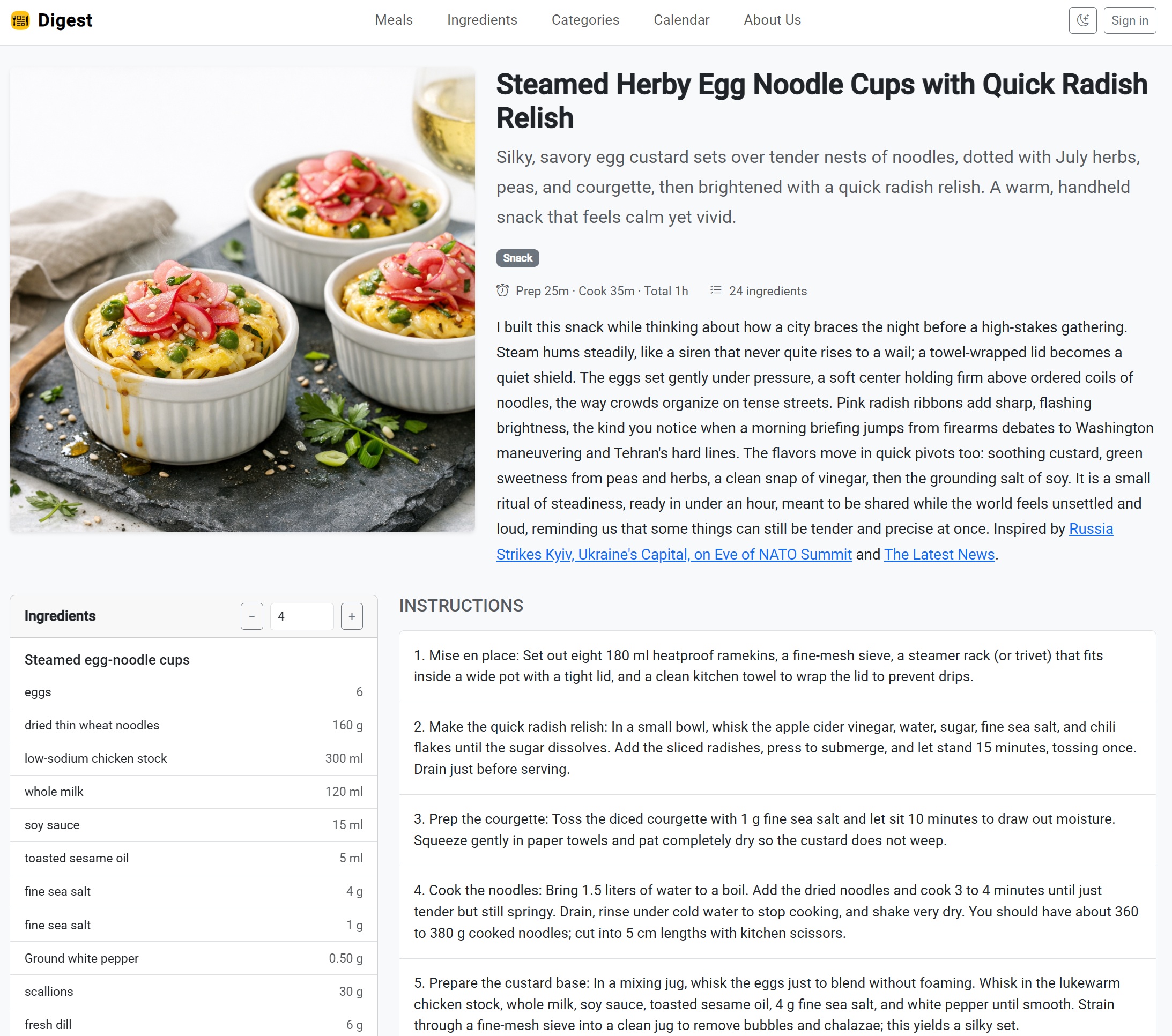
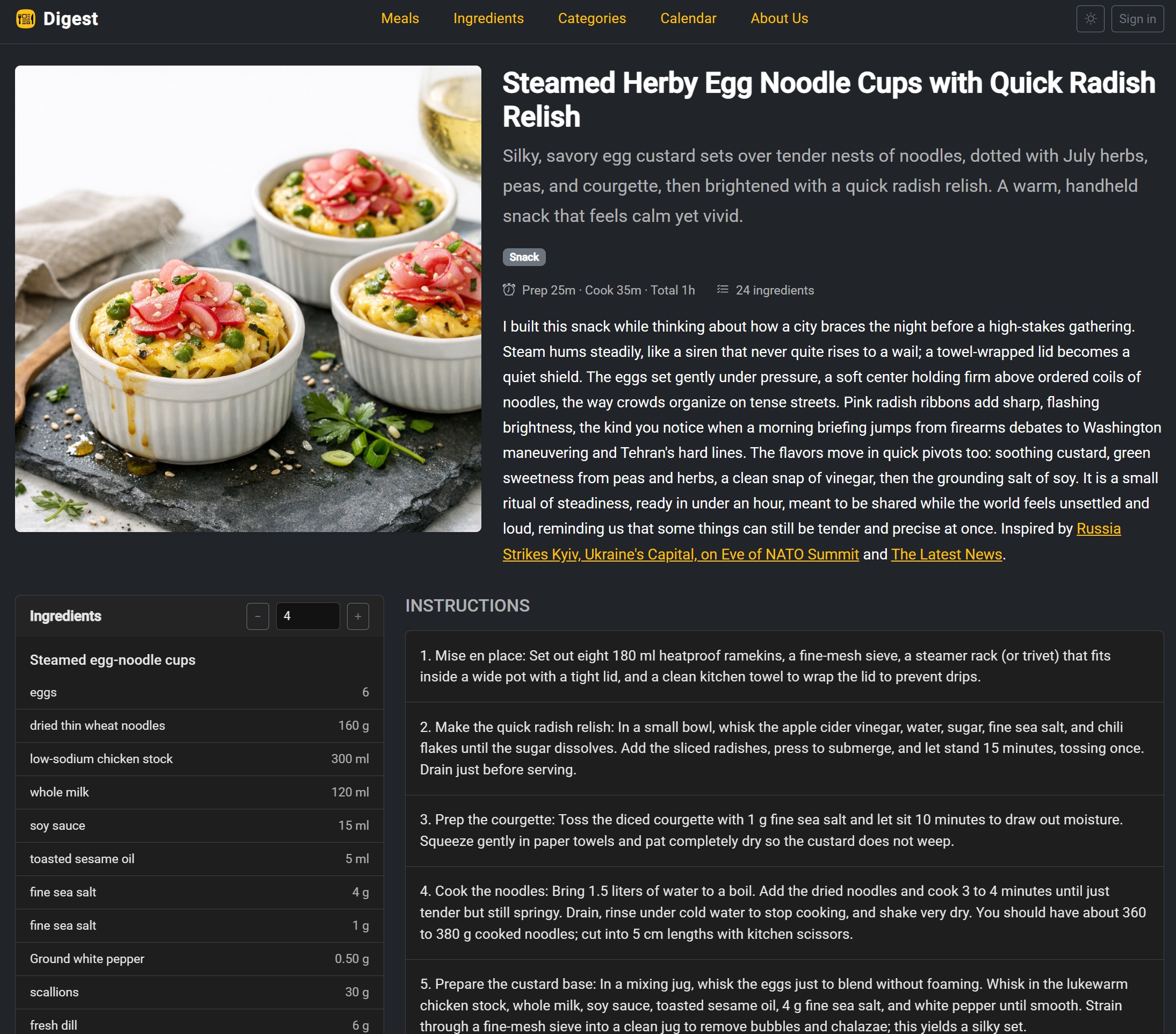
A published recipe consists of a title of at most eight words, a short introduction, an "inspiration" note of 120–200 words that ends by linking the two source stories, one of ten fixed course types, prep and cook times, a scalable ingredient list organised in groups with quantities and units, numbered instructions, an optional cook's note, a one-line drink pairing that prefers Belgian beer, per-serving nutrition estimates, and a generated hero photograph. A collapsible "Why this dish?" panel on each page shows the provenance: the two headlines, the day's constraint draw, the mood read off the front page, and a thumbnail of the scanned front page itself.
The hard problem is not producing a recipe — models do that readily. It is producing a different recipe every day, one that doesn't turn a tragedy into a pun, doesn't converge on the same three components, and reads as if someone chose it on purpose. Most of the engineering in Digest exists to force that variety and restraint.
Why I made it
I am interested in generated content, and recipes are a good test case: the output has to satisfy hard practical constraints — quantities, timings, what a Belgian supermarket actually stocks — while still needing a reason to exist beyond "another weeknight pasta". A newspaper front page appealed to me as a source of ideas because it is unusual but structured: it changes every day, it carries places, subjects and an overall mood, and it arrives on a fixed schedule. I wanted to see whether a generation process could produce recipes that were both surprising and still practical, and whether the output could feel edited and deliberate rather than obviously generated.